History, by Architecture, Blog#02
Pyramid of Djoser, Saqqara
The Pyramid of Gaza is not the 1st Pyramid!
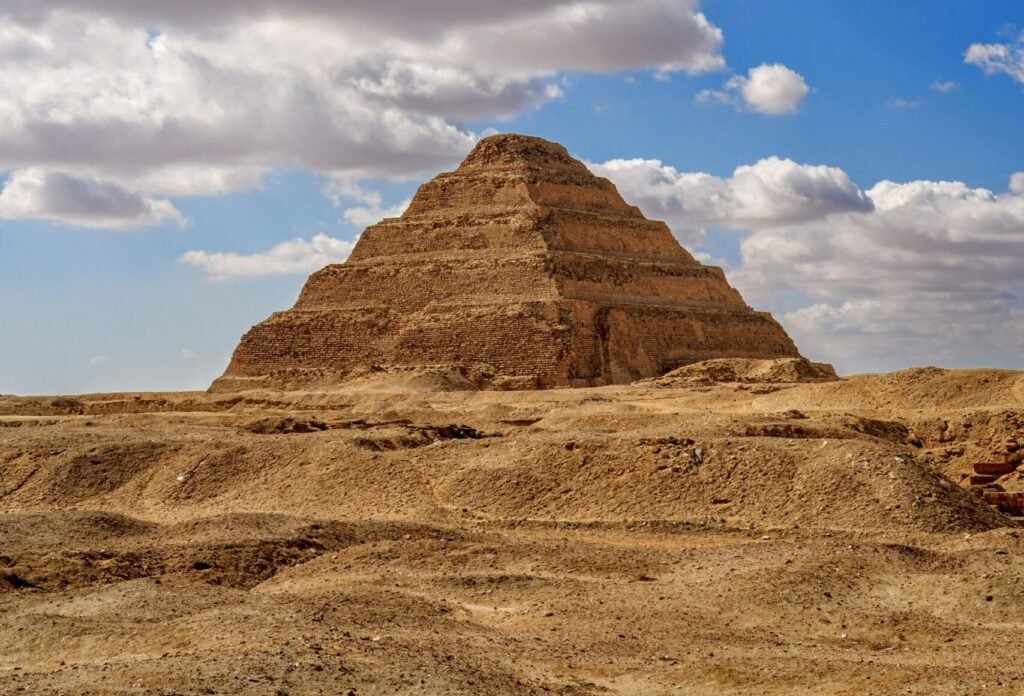
Whenever we think of Pyramids we instantly think of the Pyramids of Gaza! But did you know, the Pyramids of Gaza isn’t the first pyramid in the world! The first ever Pyramid was built 15 Kilometer South of Gaza, In a place called Saqqara, Egypt. Why was it built? What was the tecnology? What was the time period and most importantly why the architecture! Let’s understand the whole story.
Why it was built-A Brief History
Geographical
Egypt, the land of the Pharaohs, consists of a narrow strip of fertile, alluvial soil along both banks of the Nile, flanked by shelves of barren land and rugged cliffs, beyond which lie arid desert plateaus. In the Lower or Northern part, the river divides to form a great delta of sluggish outlets to the Mediterranean sea, while to the East, and roughly parallel to its course, extends the Red Sea. For such geological location and opening up to the two main seas, commanded outlets and inlets for both western and eastern foreign trade.
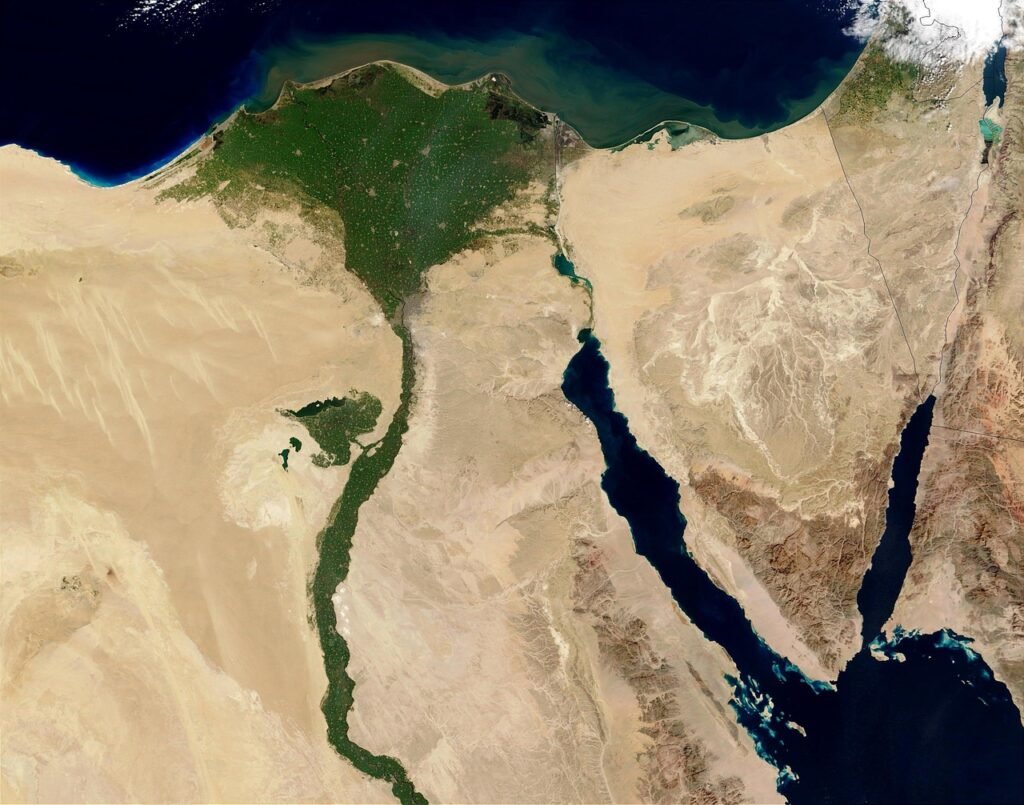
The Nile itself was the most valuable as it was not only an important trade route but also because its overflowing and fertilizing waters made desert sands into fruitful fields and it may truly be described as the rich life-blood which runs into the vine of Egypt. On the banks therefore the Egyptians sited their village, cities and cemeteries, and here are the tombs of the nobles, the royal pyramids!
Geological
The natural products, such as timber, brick, stone and clay, largely determine the character of the Architecture of a country. Egypt is a stone rich country. The resource is not only rich but it comes with variety and with different qualities. Egyptians not only use stone as a construction material but also as a decorative vase because of lack of metal resources apart from copper. For building construction limestone was massively used and the interior was made with granite stones. Most of the early temples were made with this stuff. Egyptian architecture was made possible not only by the materials but also the method of quarrying, transporting and rising enormous blocks of stones into position.
Aside from the tombs and temples the villages and the small city buildings, houses and the market places were constructed with sun-dried bricks. The sun-dried bricks were a shield for the heated sun and the extreme weather of Cairo, Egypt. A small amount of timber, wood were used for boats and the preserved mummies. Cedar and other woods were imported. Palm leaves, reeds and rushes and similar light materials, used to frame or reinforced mud=-brick construction or as mats for such as panels , partitions and fences, had a great and permanent influence on the form and character of stone architecture.
Climates
In Egypt, there are only two main seasons, Spring and Summer. Winter is unknown in this place. Storm or rain is too rare. Most of the time in a year the sun is hot and the environment is very humid. Thus the preservation of buildings and structures from this hot climate is very important in this area. To do so, the building design is mostly solid facade with no windows. The limestone facade or the dry brick protects the interior from massive sunlight. Only some slits on the roof or small opening is sufficient to pass the natural lights and the wind. Not only that, this type of facade also gives the interior a comparatively cooler environment as the heat from the sun takes a long time to penetrate the facade. Even they construct the roof with stone slabs and as the rain is very rare so the consideration of storm water drain is very negligible thus contributes to the solid form of Architecture.
Religion
The Egyptian religion is very traditional, virtually unchangeable, mysterious and these traits reflect the pattern of Architecture, both of tombs and temples. The religion is Monolithic in theory but by practise it is Polytheistic. The cult of many gods represents natural phenomena and the heavenly bodies such as the sun, the moon and the stars and by the worship of animals as personification of gods.
“In the midst of life we are in death.”
Lets see some of the gods of the Egyptian religion.
Ammon- The sun god
Mut-Sun god’s wife, the mother of all things
Khons- their sons
Path-a creator
Sekhmet-goddess of war
Osiris-God of dead
Isis-His wife
Horus- The sky god
Hathor-goddess of love
Set-dread god of evil
All these beliefs tend to the architecture of the tombs and temples as the inside of the precis should be separated from the outside. They worship the high priest dead inside of these pyramids , which they used as a temple to worship the gods. The height might be the symbol of the reach of the sky to their gods.
Social
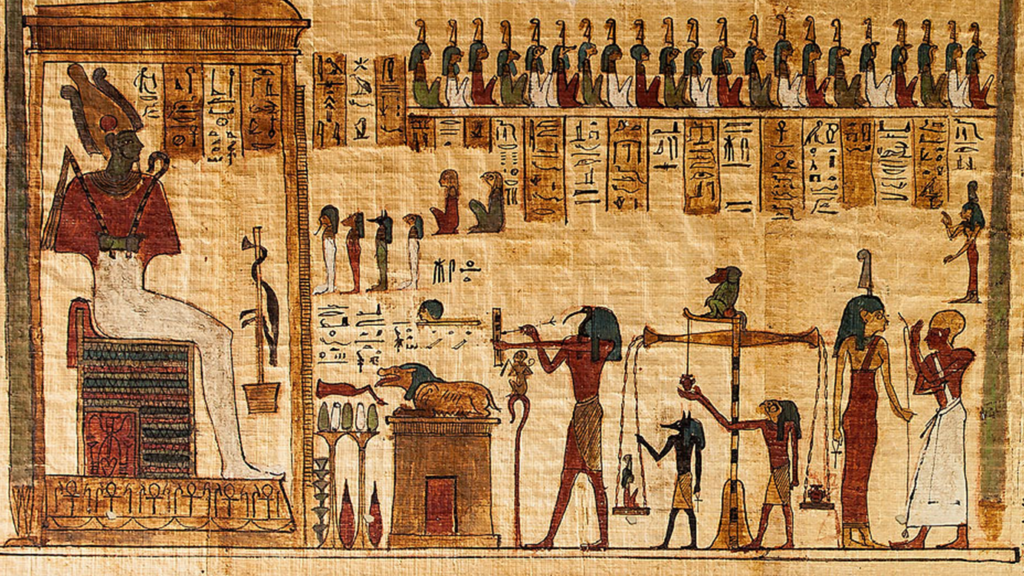
The kings of ancient Egypt are known as Pharaohs, a name given by the Hebrew and derived from Egyptian Per-aa, the ‘Great House’. In ancient Egypt they acted as a god or demi-god. They would act as a front liner to all of their wars and social conflicts. They acted as a king and all the high decisions were made by them. After the death of pharaohs they were kept on the Pyramids as a symbol that they were never dead and common people would have given them fruits and food through the gateways of Pyramids. By doing such and building more and more structure they had given a message of their power and longevity and to continue with their descendants. The bigger the Pyramids symbolises the bigger power of the dynasty. The Pharaohs have been divided into thirty dynasties.
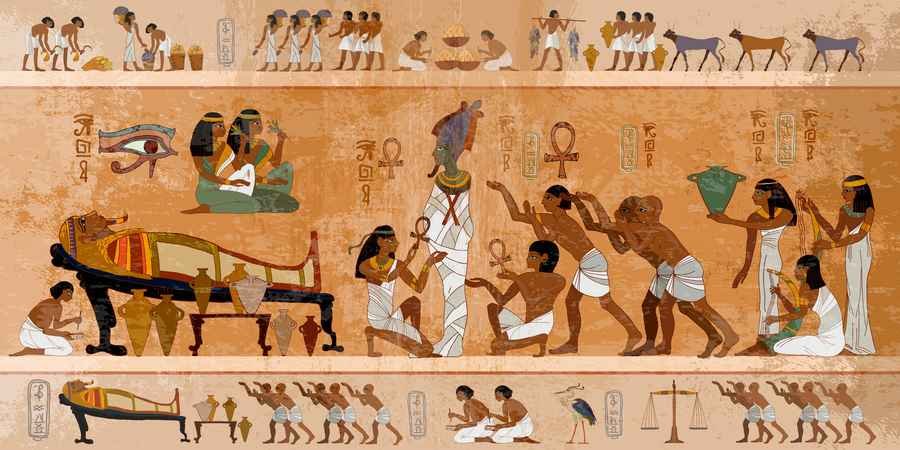
History & Architectural Character
The tombs were of three main types:
A. Mastabas
B. Royal Pyramids.
C. Rock Hewn tombs.
The tombs of the kings and nobles were of the ‘Mastaba” types, rectangular with flat floor and tops; these, like the houses, were built of sun-dried bricks. In the Third Dynasty the Royal Mastaba evolved into a true Pyramid- The ‘Step; Pyramid of the pharaohs Djoser at Saqqara.
What is a MASTABA?
As the Egyptians believed afterlife with their utmost passion, they built tombs and temples that lasted as long as the world! At least that’s what they believed. To preserve the body and to bury with it the finest commodities that might be needed for the sustenance and eternal enjoyment of the deceased. In the Third Dynasty they initiated the construction process and perfected it in the Eighteenth.
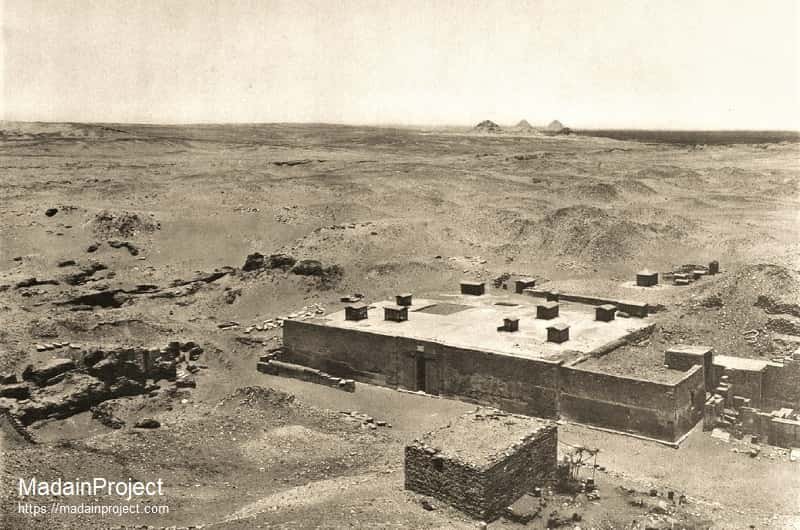
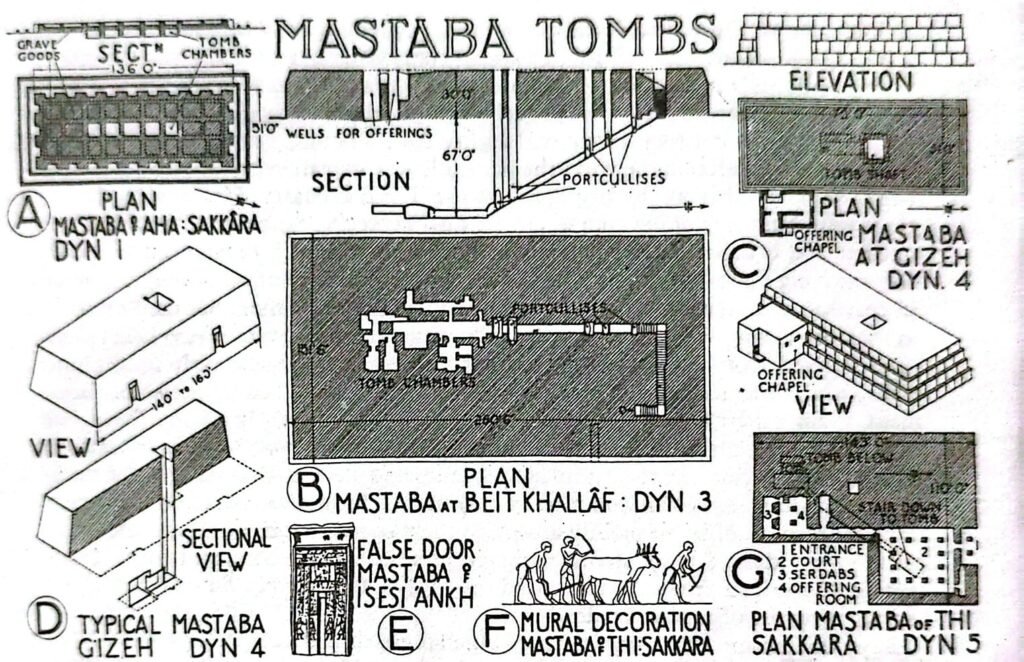
By the first Dynasty, the more elaborated graves had come to simulate house plans of several small rooms, a central one containing the sarcophagus and others surrounding it to receive the abundant funerary offerings. The whole was constructed in a board pit below ground and the wooden roof being supported by timber posts or crude brick pillars and the entire area covered by a rectangular flat -topped mound of the spoil from excavation, retained in place by very thick brick walls. The outer faces were either serrated with alternate buttress like projections and narrow recess which is called ‘Palace Facade’ arrangement and sloped backwards at an angle of about 75 degrees. Such tombs now-a-days are known as MASTABA’s.
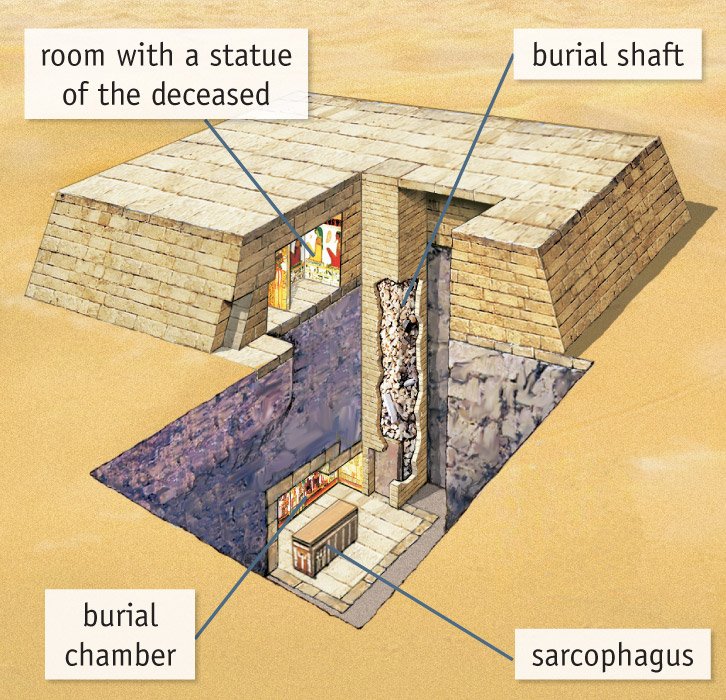
In Arabic, Mastaba means Bench. This was named as such because this is what it looked like from outside. In the Second and Third Dynasty the mastaba’s evolved as the ‘Stairway Mastaba’ with the magazine sunk much deeper and cut in the rock below.Basically the main axis of the tombs lay North to South and steps and the ramps led from the north end of the top of the Mastaba to connect with a shaft which descended to the level of the tomb chamber. After the burial heavy stone portcullises were dropped across the approach from slots built to receive them and this was then filled in and all surface traces removed.
The Step Pyramid of Djoser, Saqqara (2778 B.C. Third Dynasty)
This is remarkable as being the world’s first large scale monument made of stone. King Djoser’s Architect, Imhotep, invented a masterpiece of architecture there. The sheer age of the Step Pyramid is astounding. It was built in the early Third Dynasty, during the reign of King Netjerykhet (c.2667–2648 BC), who is now more well-known as Djoser. The two courts in front of the pyramid recreate the setting of the Sed Festival, a royal ceremony aimed at rejuvenating the king and regenerating his power. The structures on the side of the eastern court emulate in stone the ephemeral shrines that were used in this festival, thus ensuring that the king could continue being rejuvenated forever.
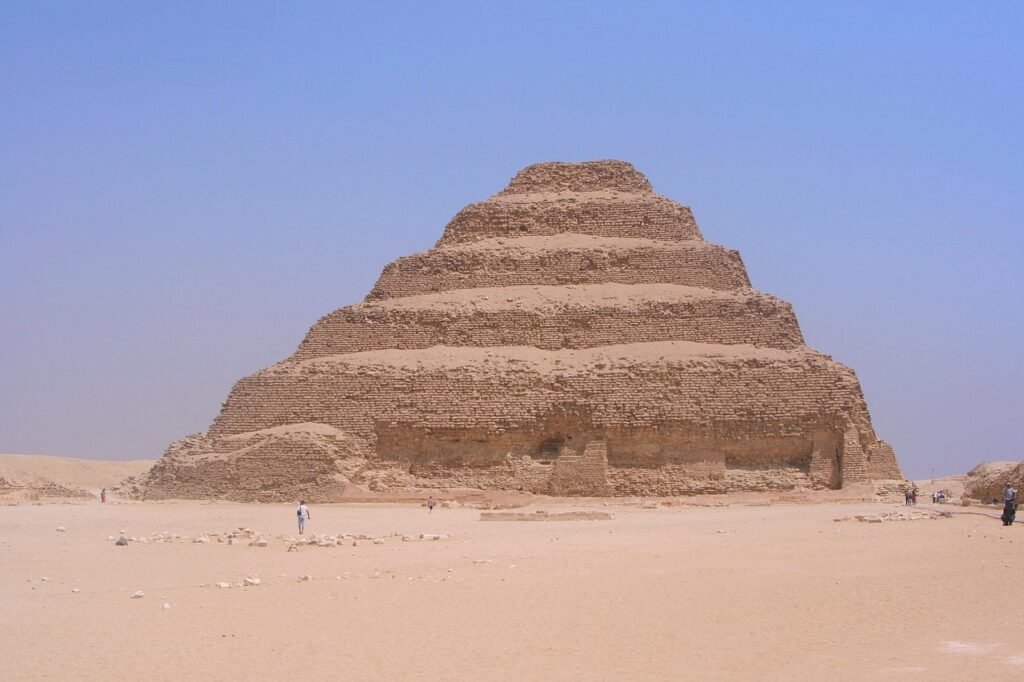
The pyramid itself shows no less than five changes in the course of its construction period. It started as a basic MASTABA with a 26ft height with a base of a square shaped plan with 207ft of sides. After that it was extended twice. At first the additional 14ft height to each of the sloping sides and next by an extension on the Eastwards by 28ft. At this stage the whole was used as a basis for a four-stepped pyramid, made up of layers inclined against a steeped slide core and again enlarged at the same time so that its plan became a rectangle of about 272ft by 244ft. A further enormous addition on the North and West followed by a quite slight one all round, brought it to its final dimension of 411ft from East to West, by 358ft wide and 200ft high. Adding these steps to the height makes it a six stepped tomb. Usually the underground chambers were built before the superstructure was made but in this case a pit of 24ft side and 28ft deep was the counterpart of the first Mastaba, approached by a horizontal tunnel emerging at the North side in an open ramp;but this pit was deepened to 92ft at the pyramid stage of development and had an Aswan Granite tomb chamber at the bottom above which was a limestone-walled room containing a granite plug to stop a hole at the top of the tomb-chamber when the burial had been completed. The second tunnel is 70ft deep. From the bottom of the pit four corridors extended towards the four cardinal points, connecting to galleries running in approximately parallel with the four sides of the pyramid. Independent from the main system there are eleven separate pits 106ft deep on the East side of the original mastaba. These were the tombs of Royal families. The doorways were sealed by the Third extension of the Mastaba.
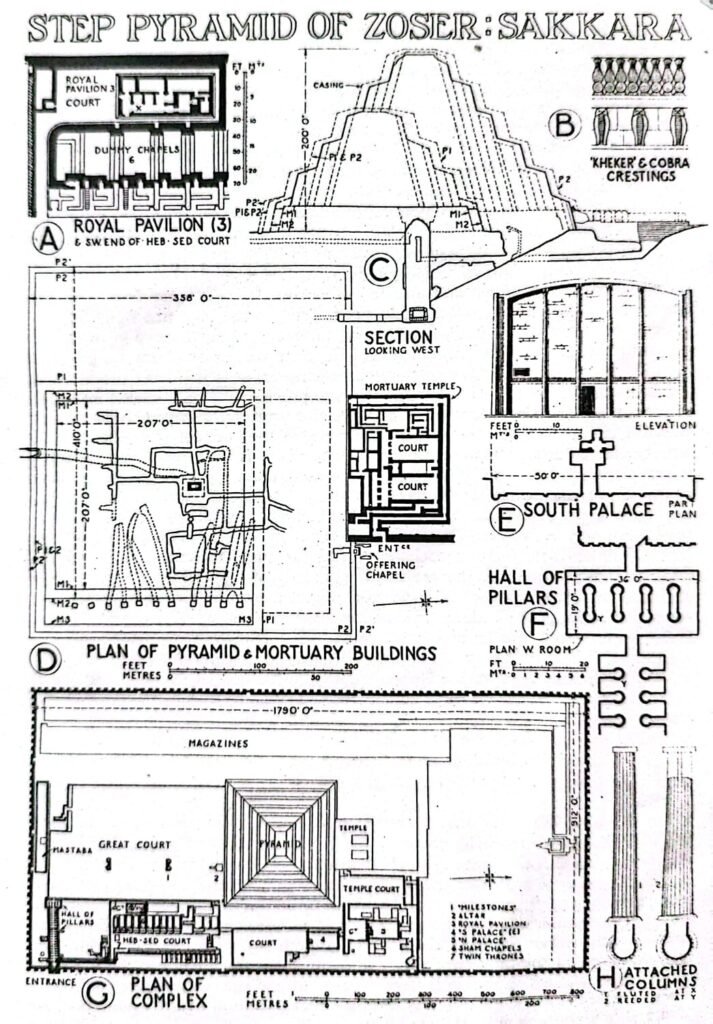
The Complex
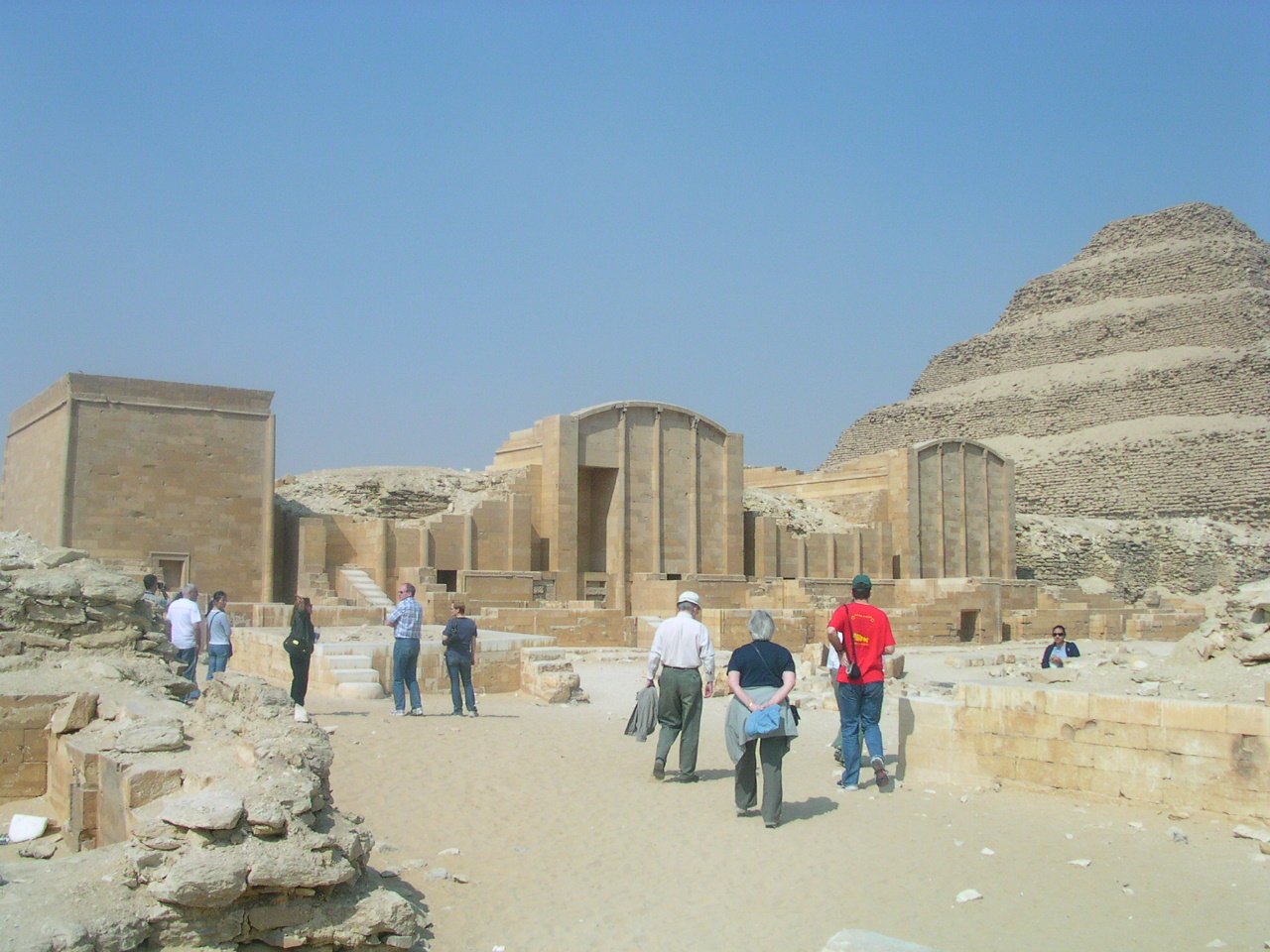
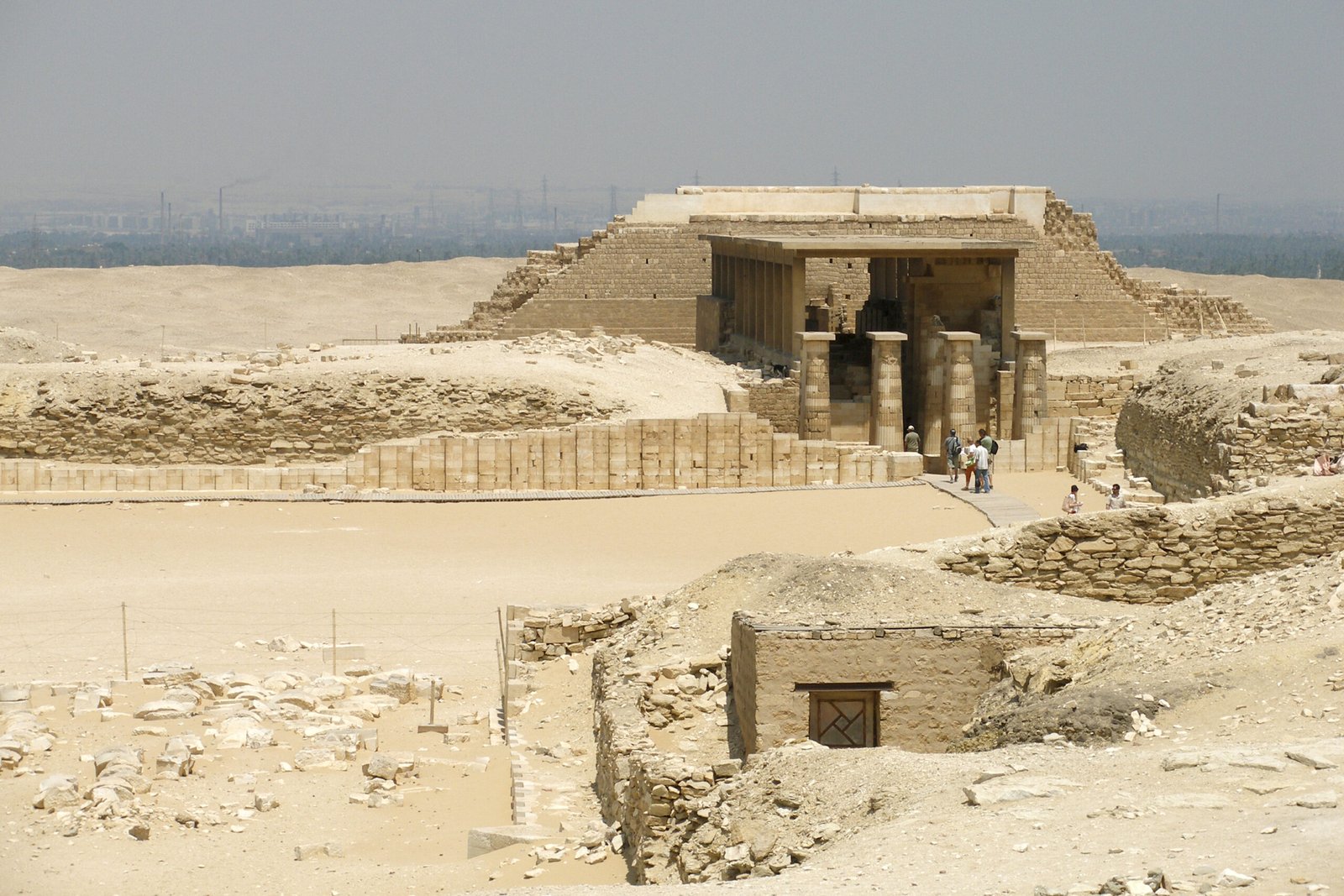
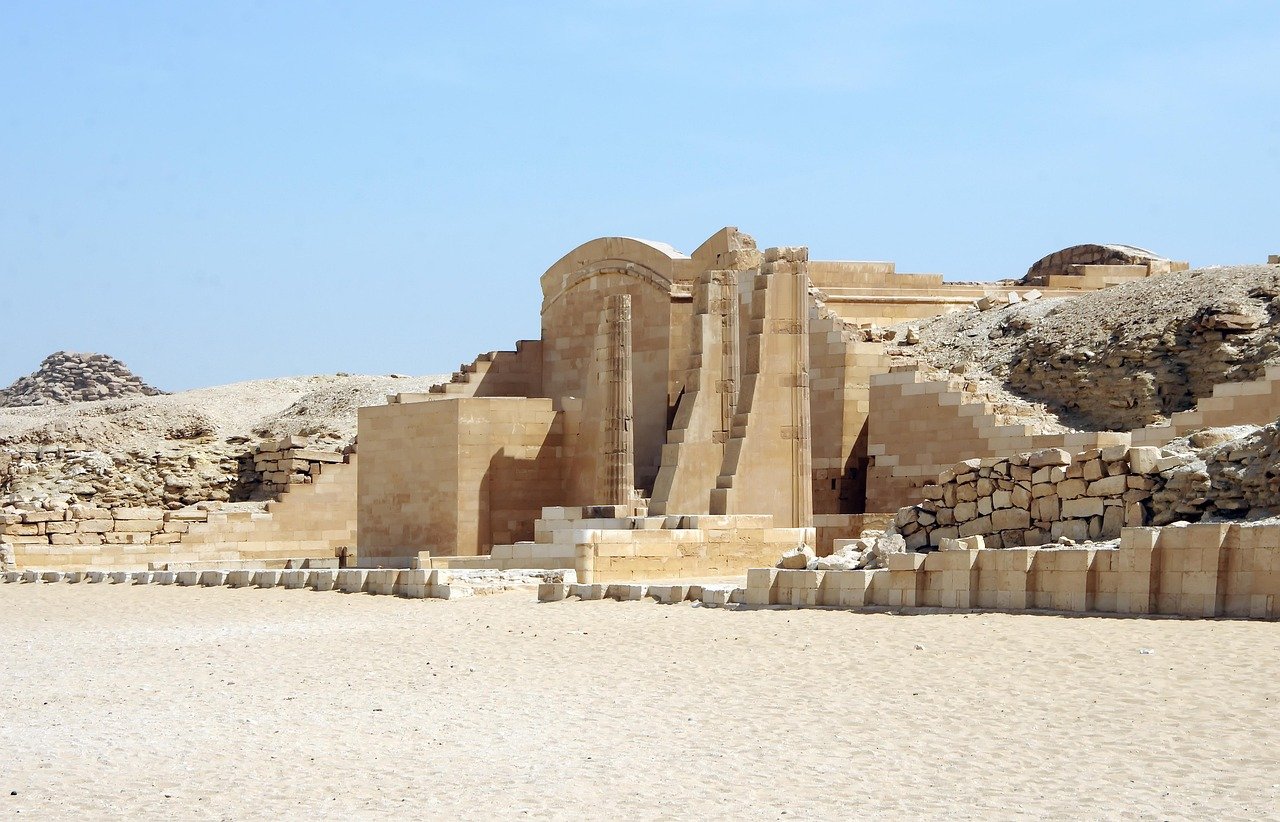
A complex measuring 37 acres (15 hectares) stands at its epicenter. The complex is encircled by a sunken limestone wall, and on the southeast side are faux portals as well as actual colonnade entrances, according to Lehner.
On the pyramid’s north side, there is a temple and a statue of the ruler. The statue is surrounded by a tiny stone building called a “Serdab,” with the king’s eyes visible through a hole in the serdab. A large court with an altar and stones that have been recognized as border marks is located to the south of the pyramid, according to Lehner.
A number of façade “dummy” structures were erected in the complex by the builders, including a number of chapels in the southeast and north and south pavilions on the pyramid’s east side. According to Lehner, these buildings would have been used for religious purposes and, oddly enough, it appears that their builders partially buried them. A court where the monarch might perform the Heb-Sed jubilee festival, supposedly in the afterlife, is located on the southeast side of the complex, next to the mock chapels.
The mysterious “south tomb,” complete with a chapel, is located near the complex’s southernmost point. It has a network of tunnels that resemble those found below the actual pyramid.