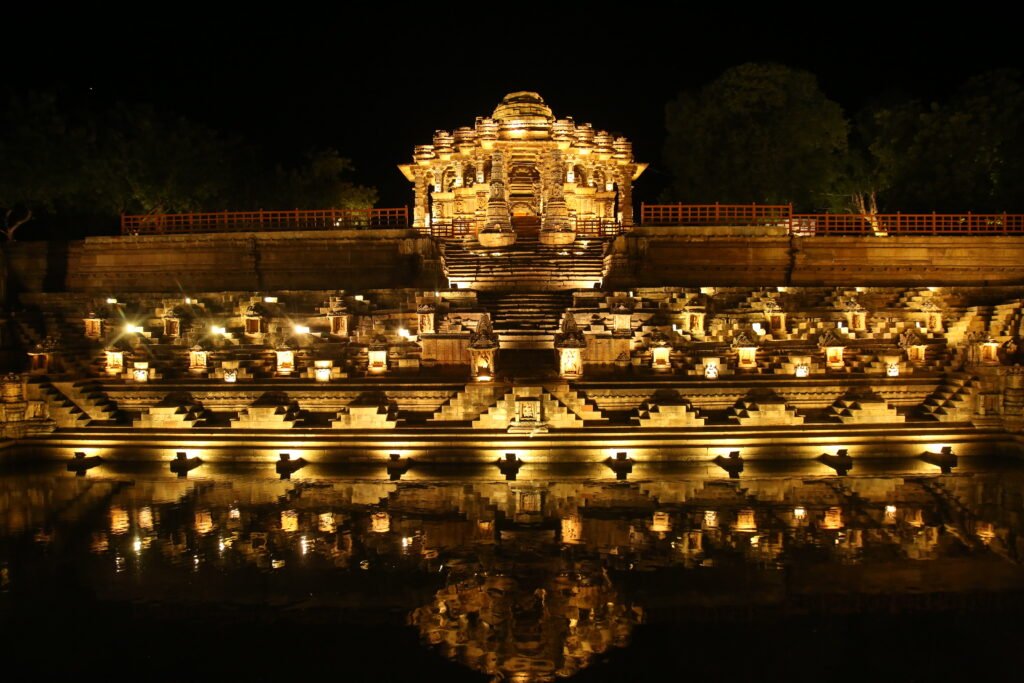
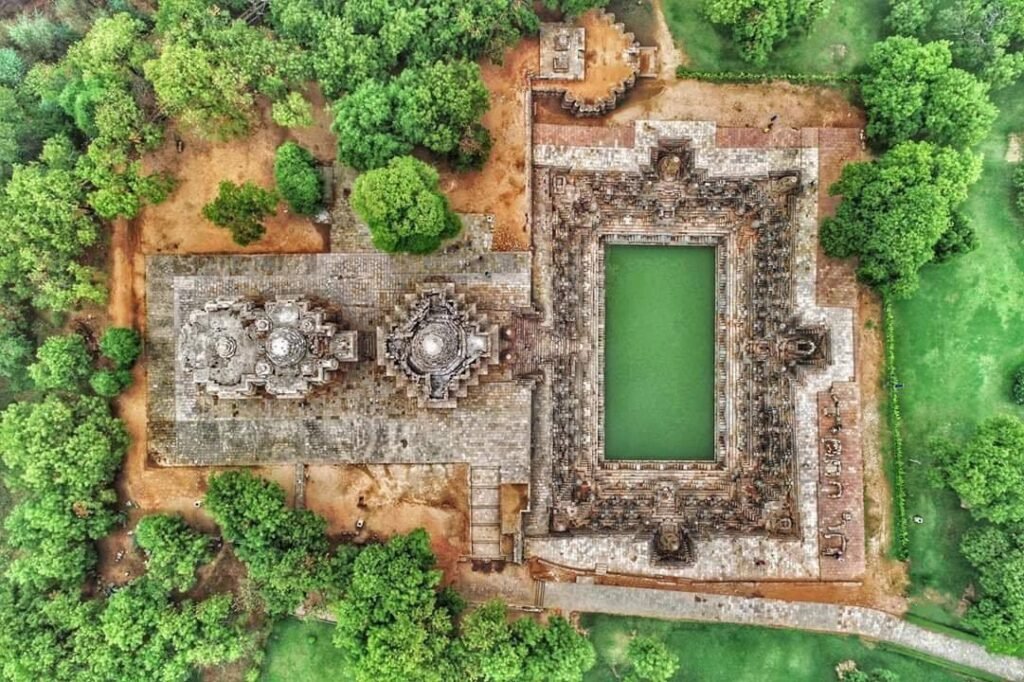
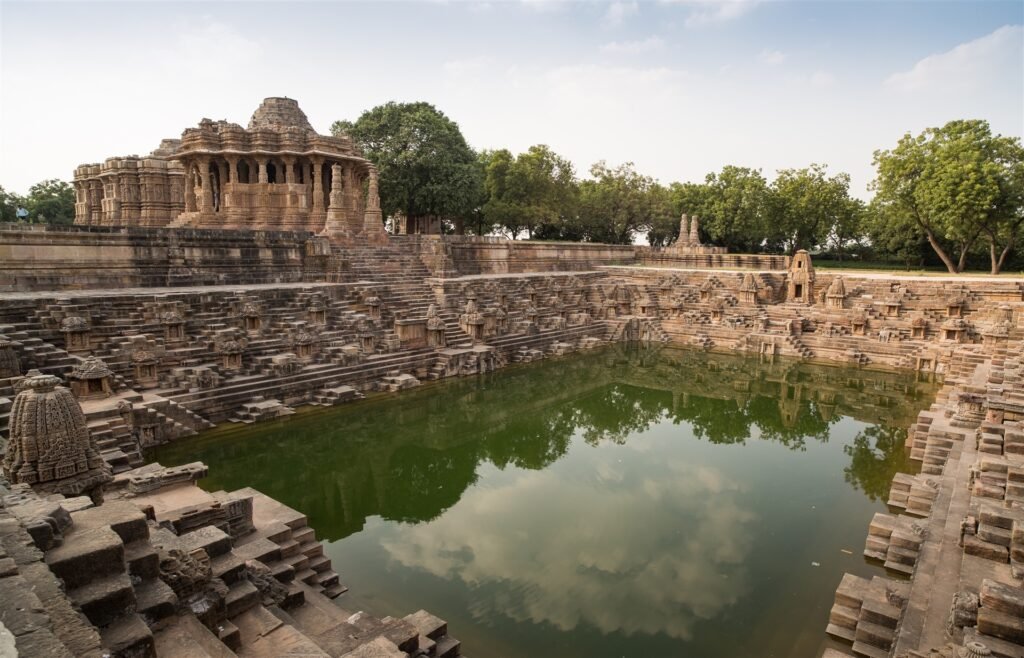
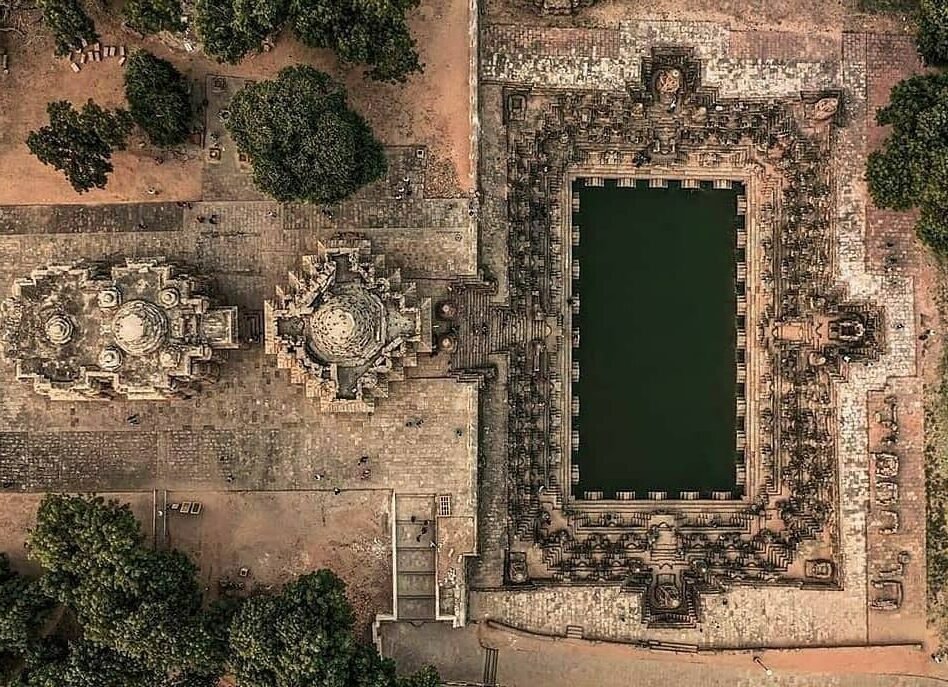
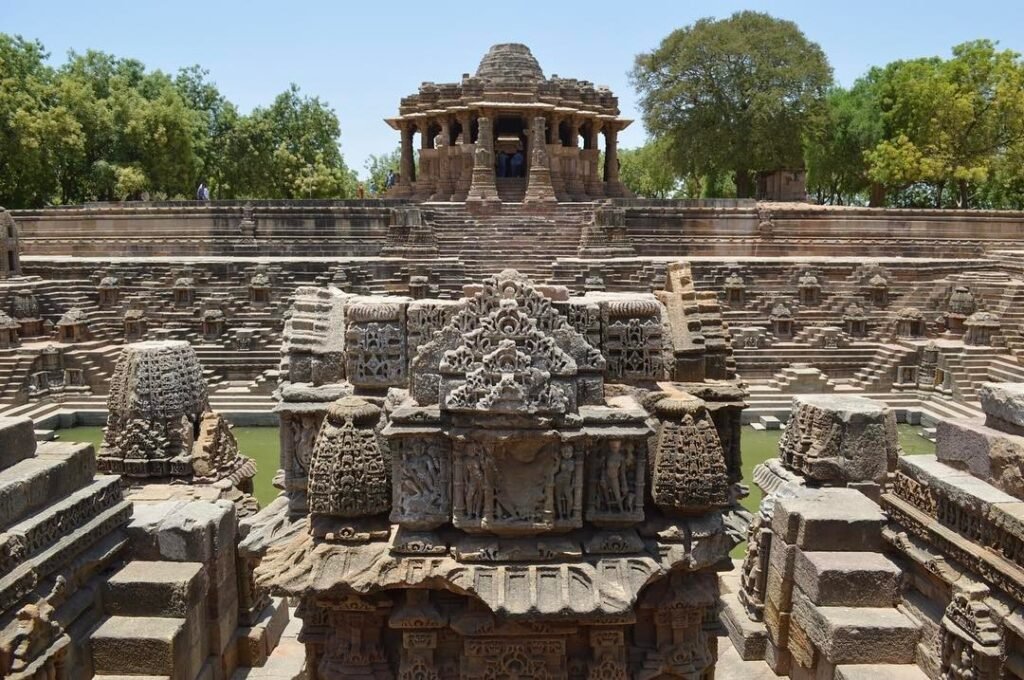
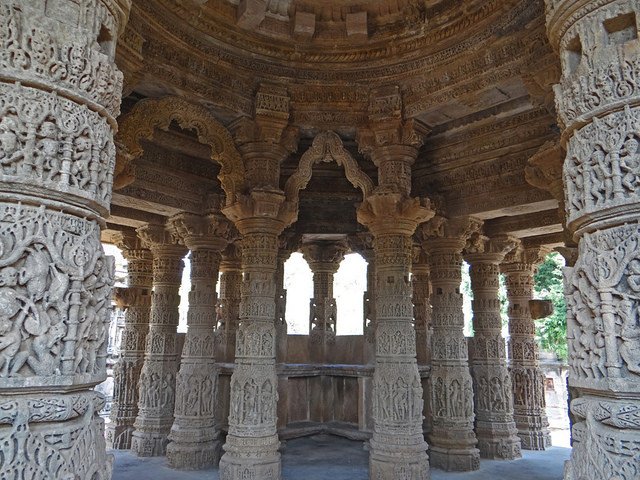
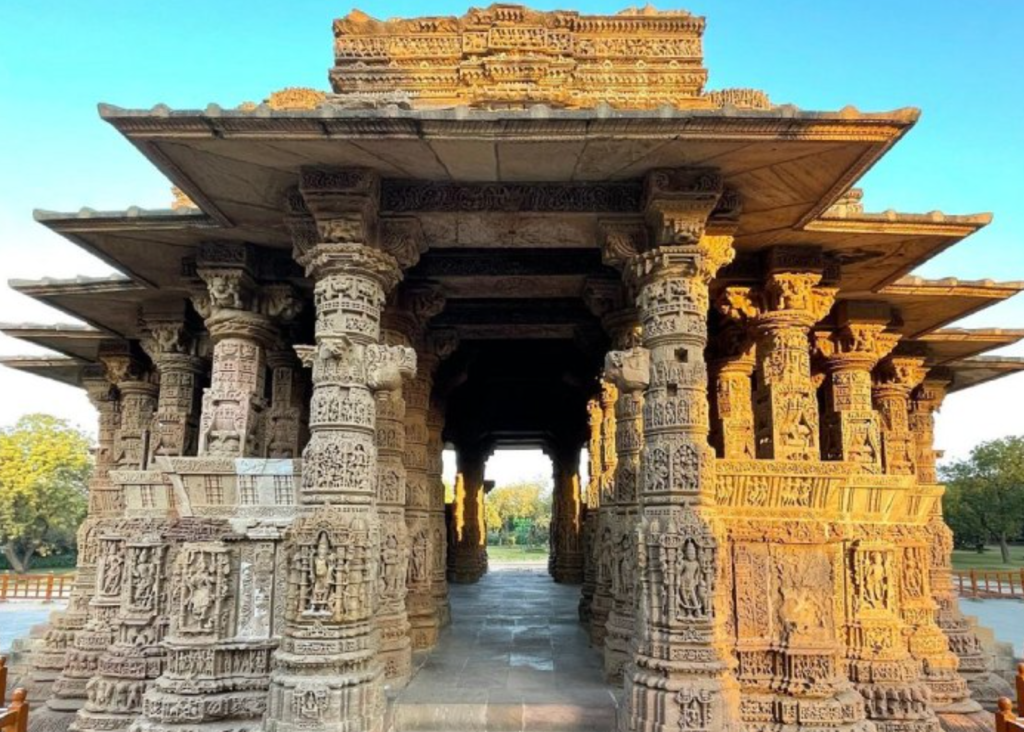
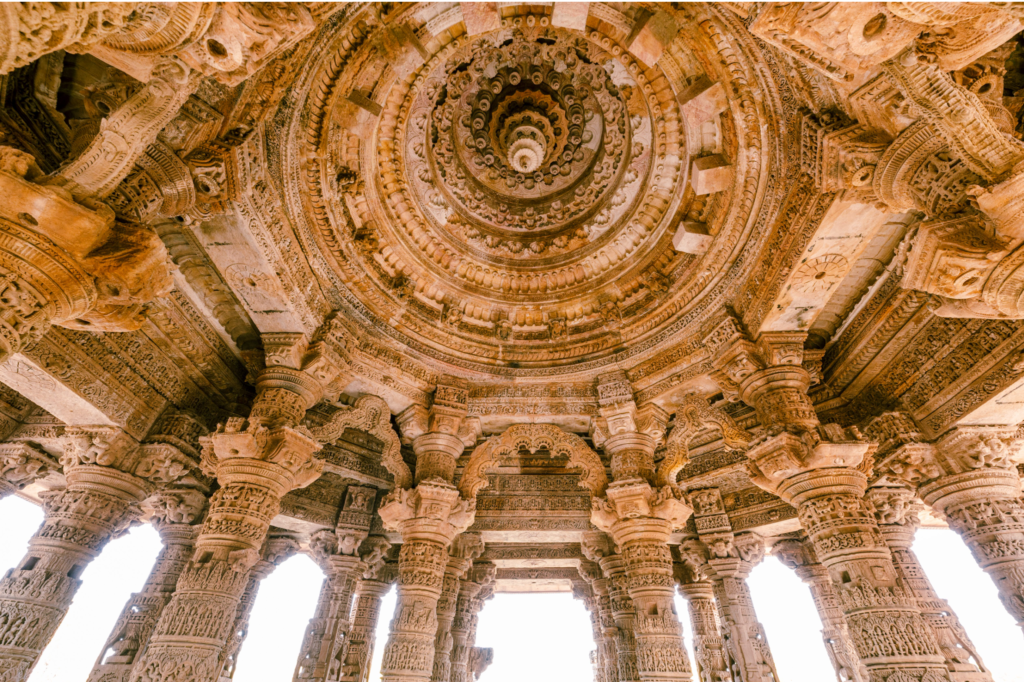
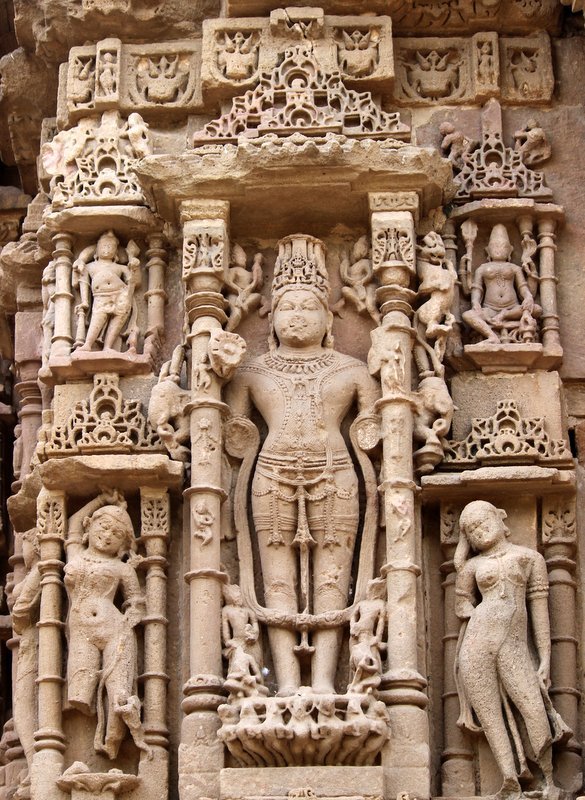
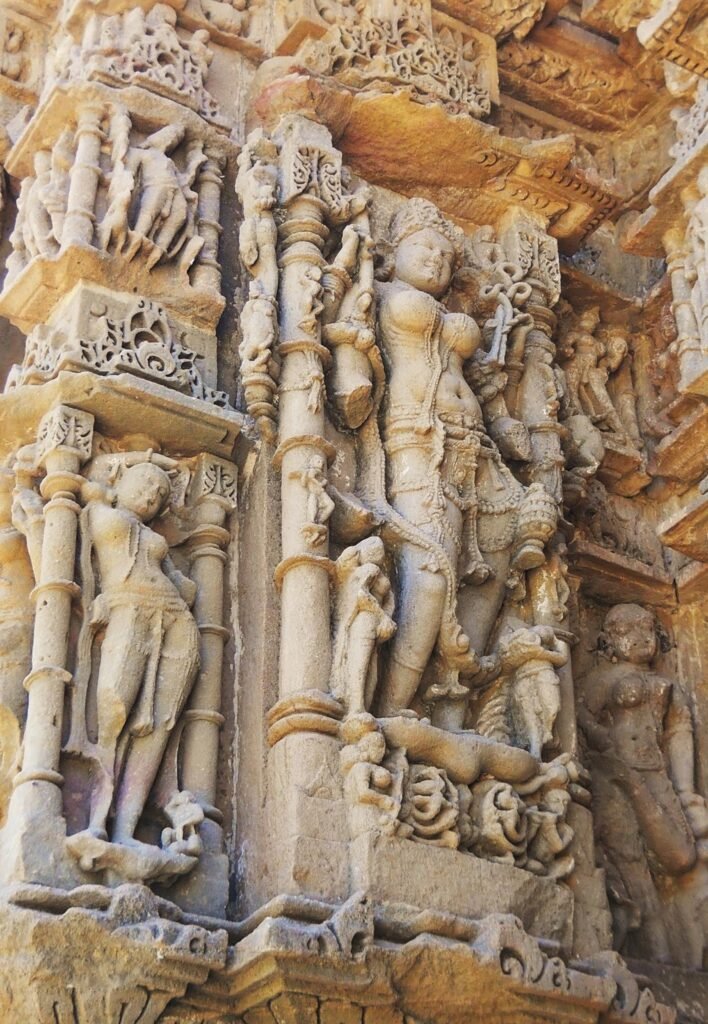
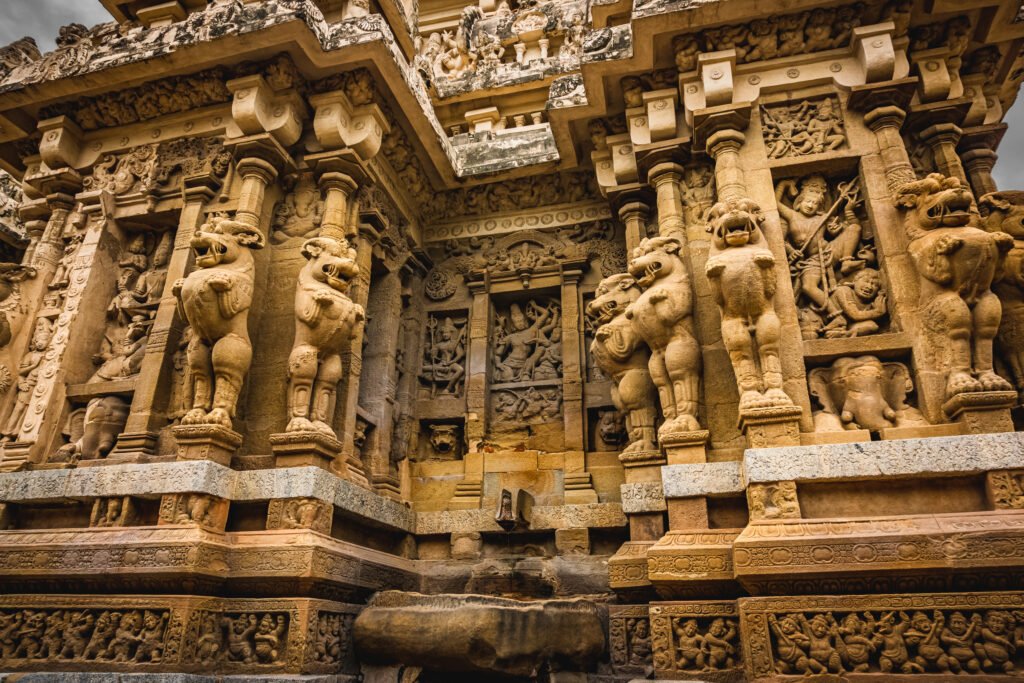
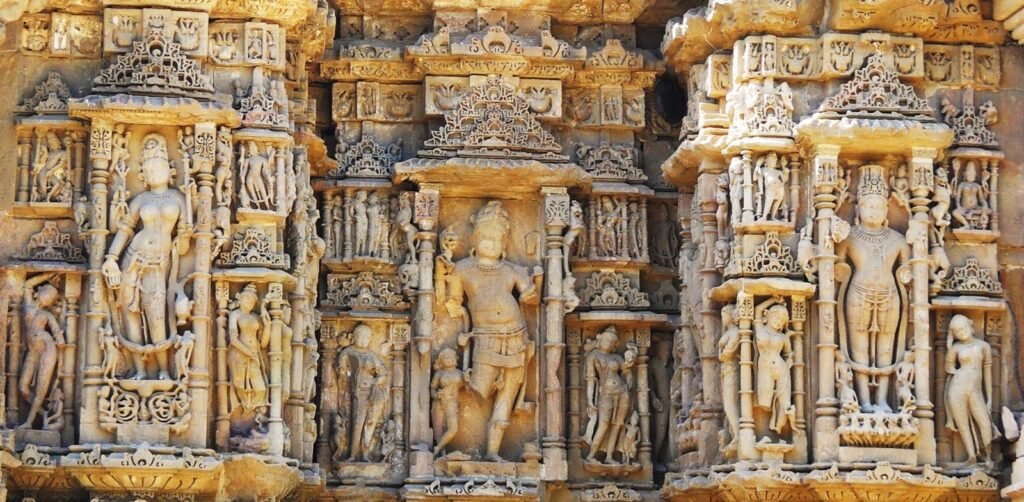
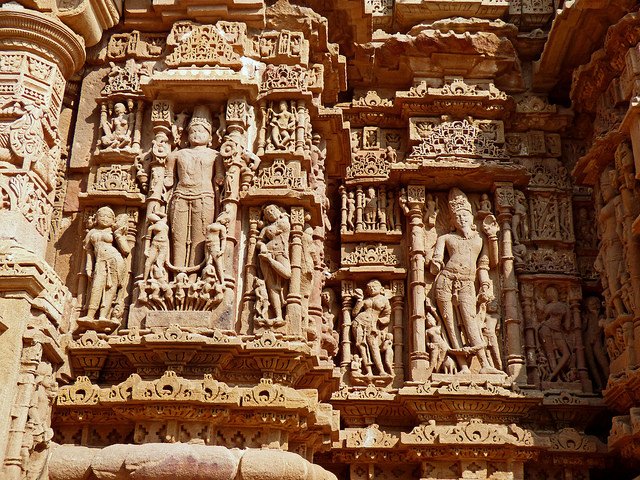
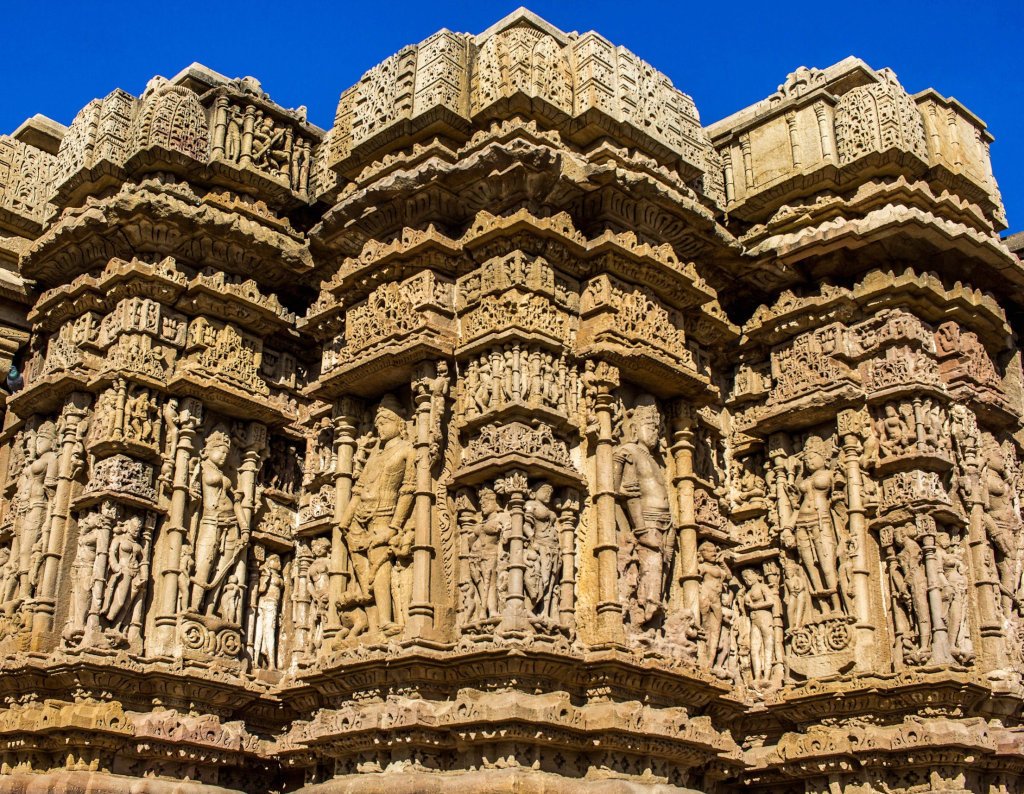
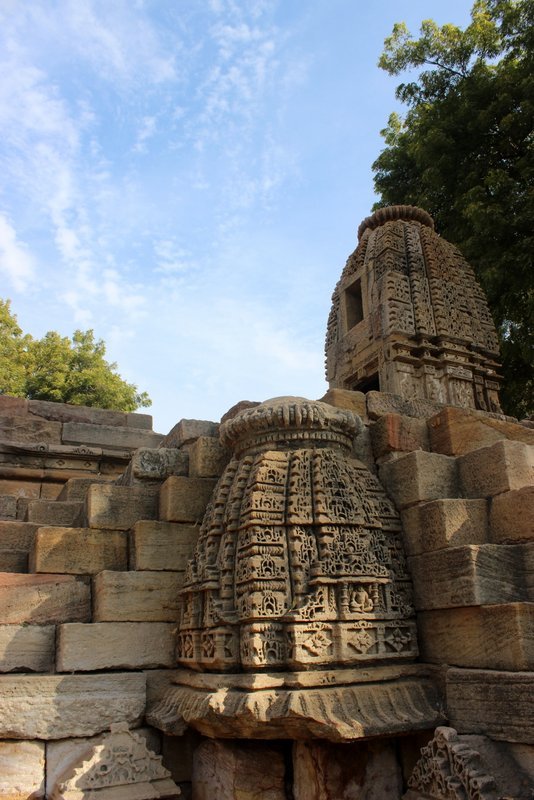
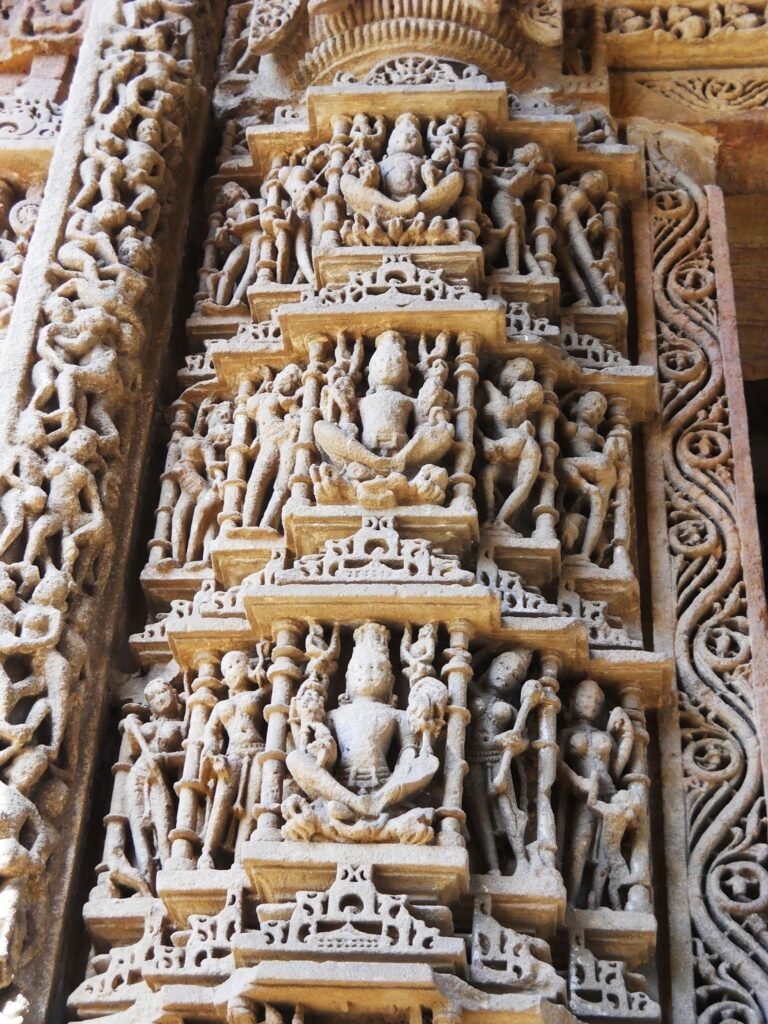
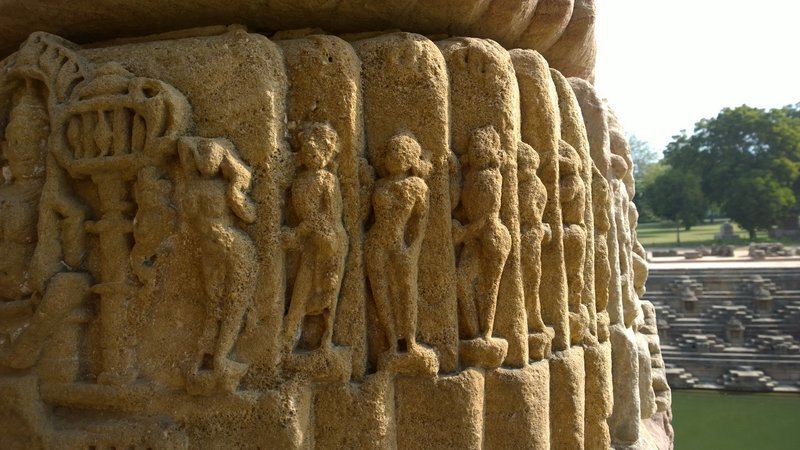
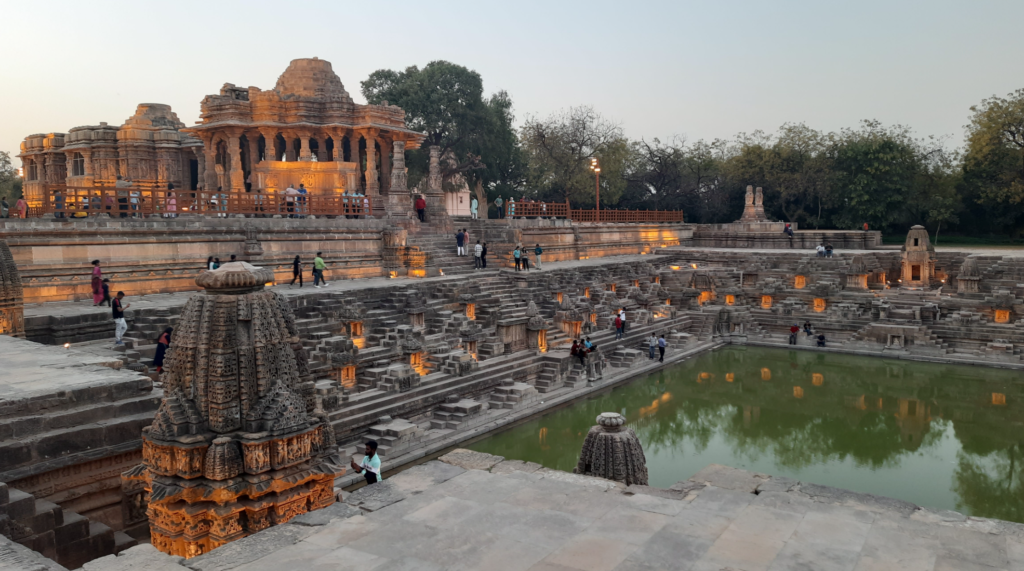
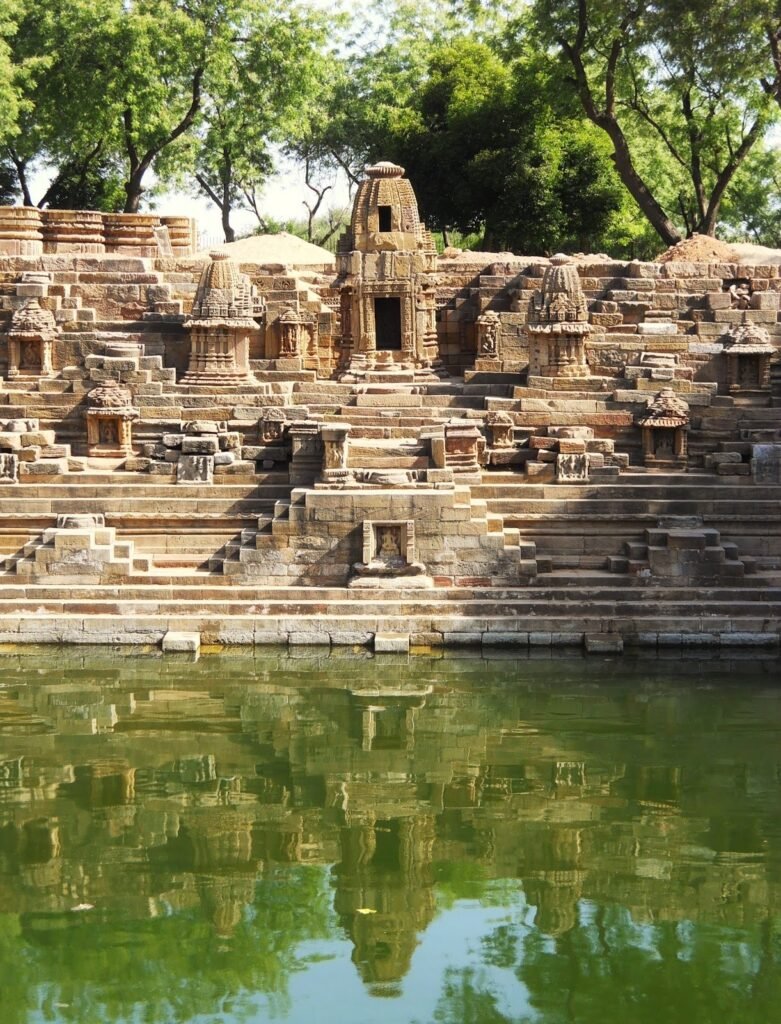
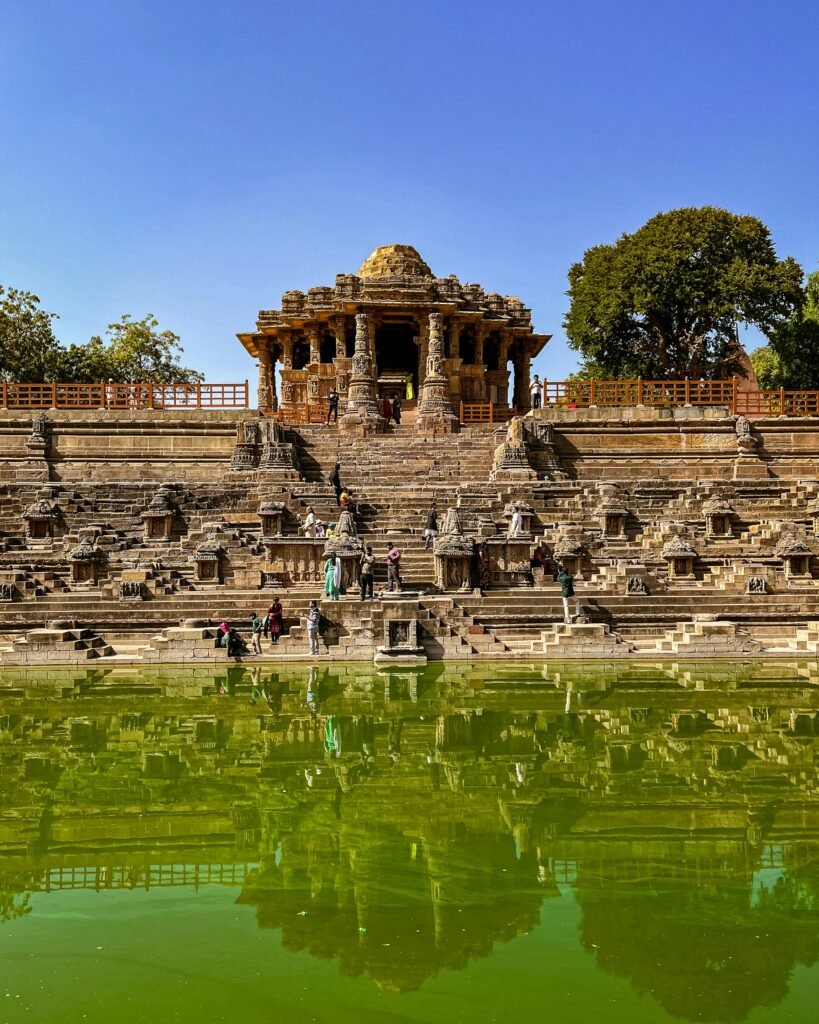
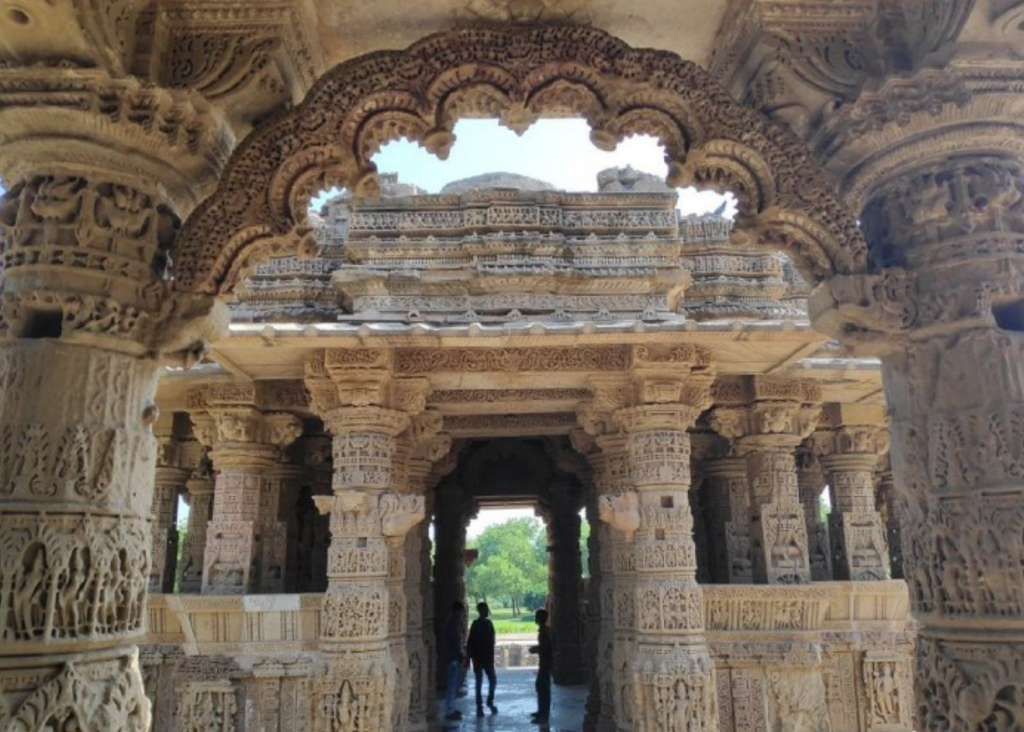
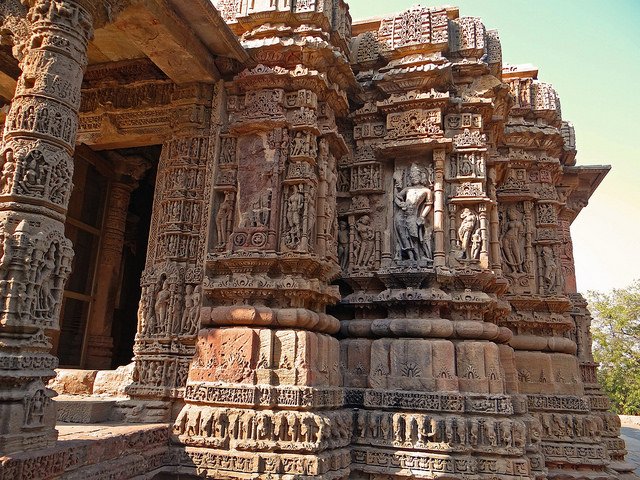
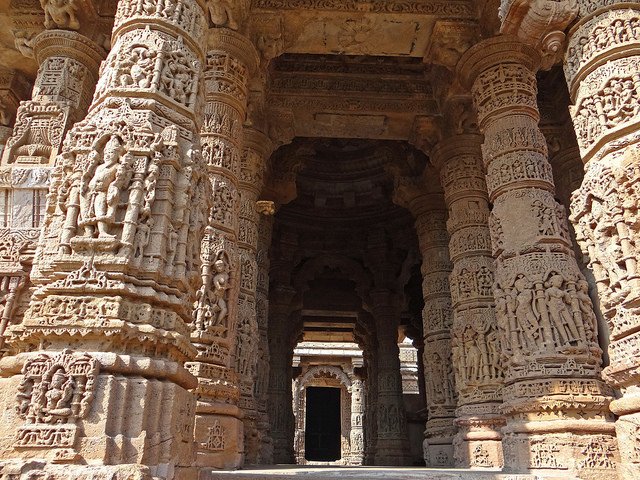
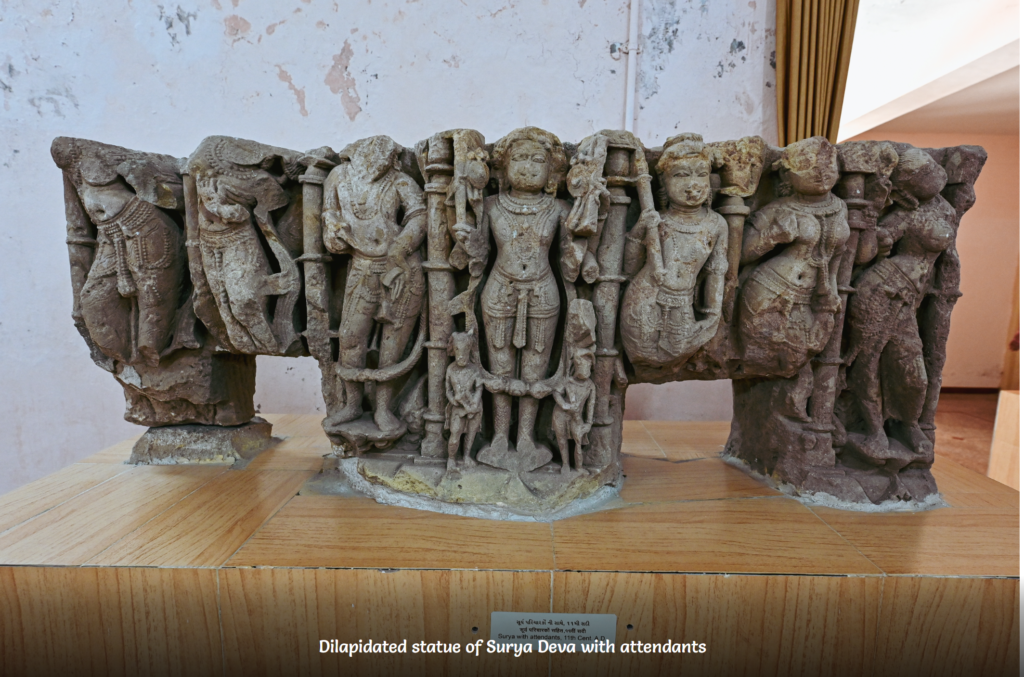
The Surya Kund in Modhera, northern Gujarat, next to the Sun Temple, built by King Bhima I in 1026 to honour the sun god Surya. It’s actually a tank (kund means reservoir or pond) rather than a well, but displays the hallmarks of stepwell architecture, including four sides of steps that descend to the bottom in a stunning geometrical formation. The terraces house 108 small, intricately carved shrines between the sets of steps. The magnificent tiered reservoir of the Sun Temple at Modhera. This kundh was more than just a water tank; it was an integral part of a bigger complex of scientific and religious edifices oriented toward Surya, the Sun God. Totally carved out of sandstone, Suriya Kundh is a reflection of the Rajput era’s mastery over astronomy, geometry, climate, and ritual skillfully brought together into architectural form.
Besides being the only two Sun temples of some note in India, the Sun Temple at Modhera and the Sun Temple at Konark are considered important monuments in the architectural history of the subcontinent.
Location, Geography and Historical Context
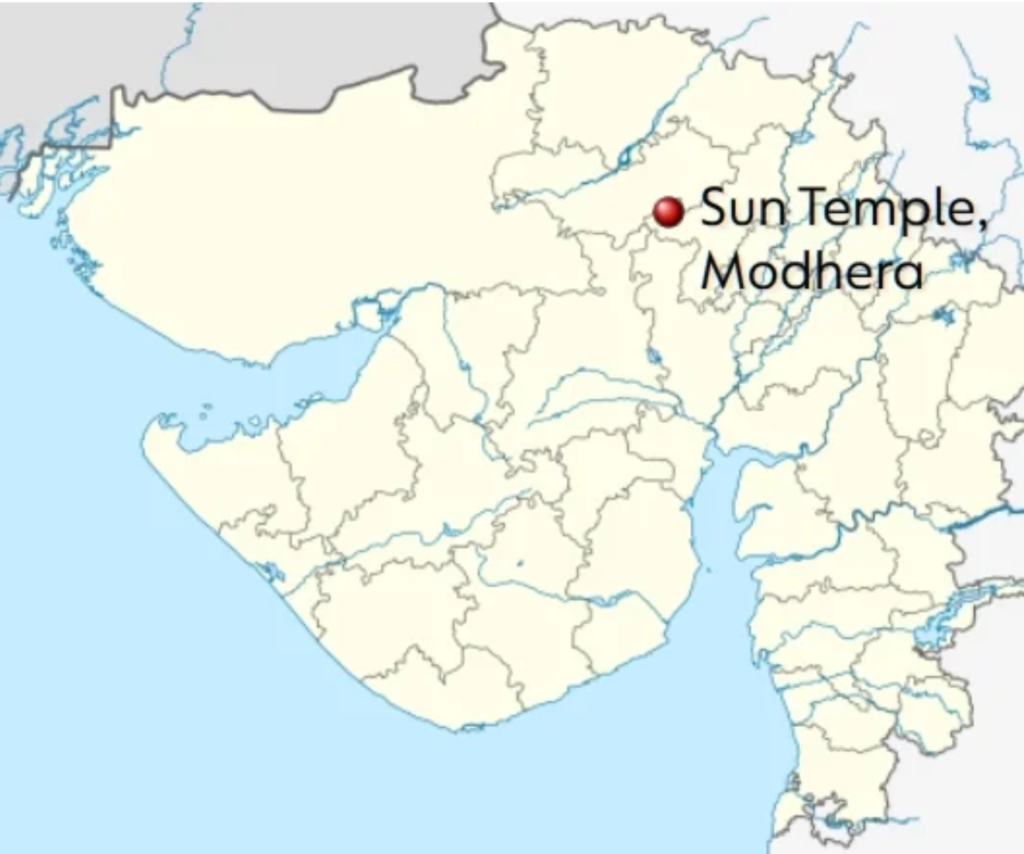
Modhera is located in Gujarat, where it can be found today. It is 32 kilometers away from Patan. Once, Patan served as the capital of the Chaulukya Dynasty, which is also referred to as the Solanki Dynasty. The Modhera temple complex is located at 23.6° north latitude, placing it in proximity to the Tropic of Cancer. This matters as it influences the way the sun’s rays strike the Modhera temple. The solar alignment of the Modhera temples is uniquely remarkable.
The Suriya Kundh was traditionally linked to the Pushpavati (Pushpa) River, which used to flow close to the temple. The water’s presence, along with the temple’s orientation and landscape, formed a microclimate that improved ritual activities and environmental comfort.
How and Why- The Man behind it!
The Sun Temple in Modhera was constructed by King Bhimdev I of the Chaulukya Dynasty. He was a mighty leader of western India. The period of King Bhimdev I’s reign was truly prosperous for temple construction and advancements in art and science. King Bhimdev I desired for individuals to create structures that reflected their faith in God. He also desired them to utilize this architecture to preserve the complex understanding of Vastu Shastra as well as astronomy and mathematics. The Sun Temple located in Modhera serves as an illustration of this. King Bhimdev I and the Chaulukya Dynasty contributed to this occurrence. The complex’s construction is thought to have lasted approximately four years, carried out by skilled craftsmen from the Somapura (Sompura) guild of Rajasthan, famous temple builders of their era.
Purpose and Time of Construction
Built in the 11th century, the Sun Temple in Suriya Kundh was designed as a ritual and scientific ensemble. The kundh, served multiple purposes:
Ritual purification before entering the temple.
Groundwater harvesting from a 20-foot-deep spring
A symbolic representation of the cosmic ocean
More than 110 kilometers of stone were transported for the construction—an astonishing logistical feat for its time.
Ancient Astronomy in Contemporary Science
The Modhera complex has a cool feature. It is about how old astronomy ideas are similar to what we know today about science. The temple is built in such a way that during the equinoxes which’re on March 20th and September 23rd the first light of the sun in the morning hits the Surya idol right on. The Modhera complex is an example of this and the Modhera complex is amazing because of how it shows that ancient astronomy was able to predict things that we now know are true, from contemporary science.
The diamond set in Surya’s golden crown reflected the sun’s rays, brightening the whole sanctum. This remarkable occurrence showcases the celestial knowledge of thinkers like Aryabhata, commonly known as the lord of light in ancient Indian science.
Architectural Facts Intertwined with Astrology
The complex is a physical calendar carved in stone:
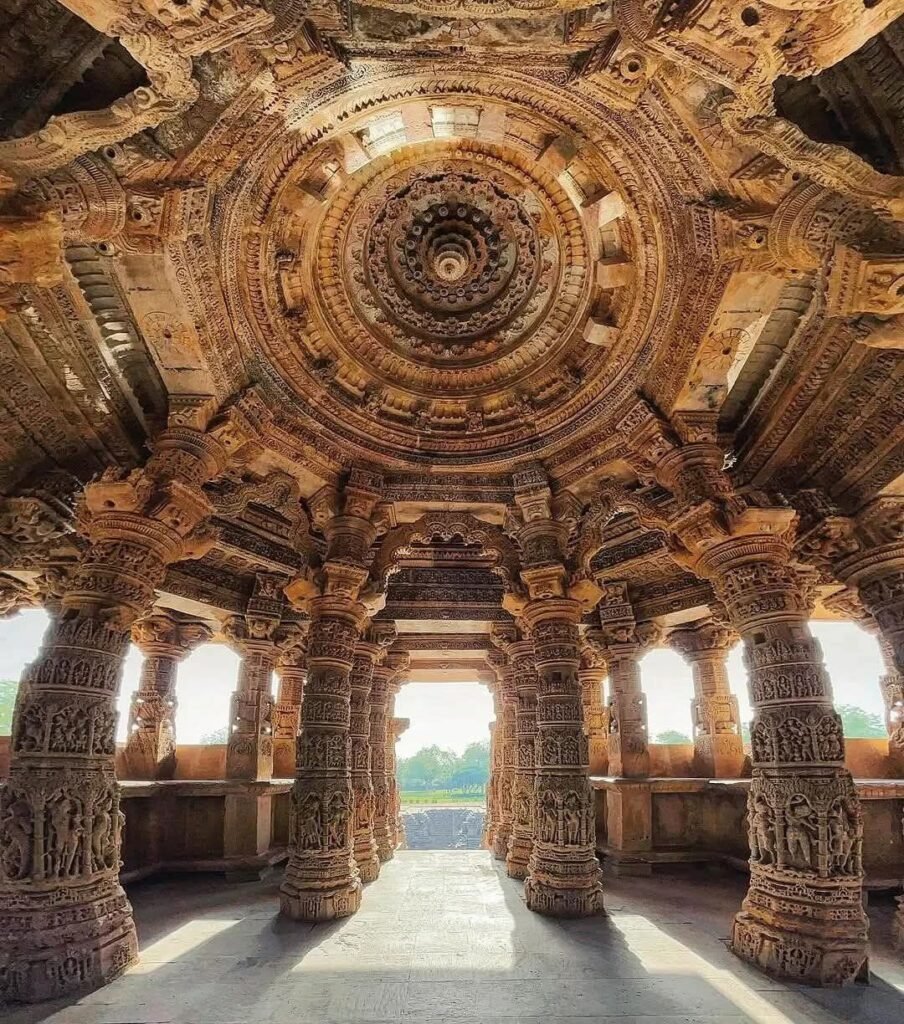
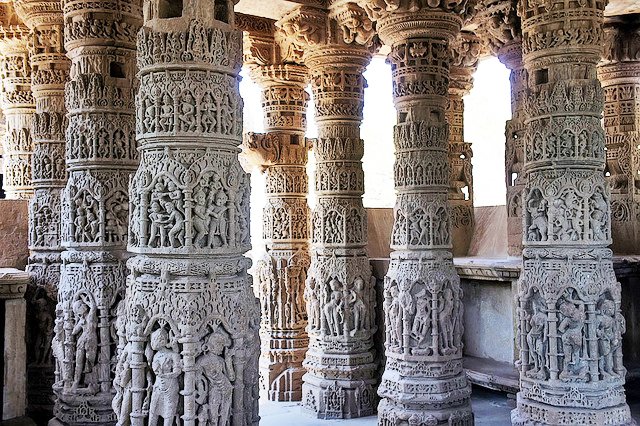
52 pillars represent the 52 weeks of a year
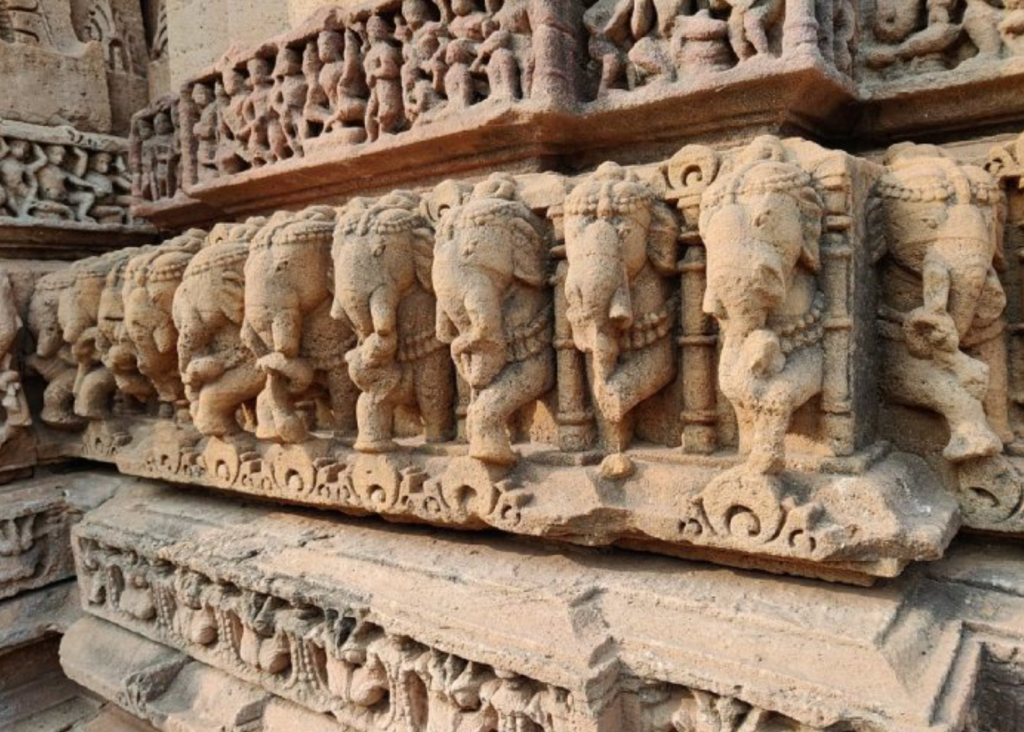
365 carved elephants in the Sabha Mandapa symbolize the days of the year.
The kundh follows a subtle 1.5-degree curvature, enhancing structural balance and visual harmony.
The temple architecture follows Vastu Shastra, blending cosmic order with spatial design.
Architectural Description of the Three Main Components
The Modhera Sun Temple consists of three primary components:
1. Suriya Kundh (The Reservoir)
A massive stepped tank protected by sandstone walls, adorned with 108 small and large shrines, each carved with Hindu deities. The triangular staircases, arranged in series, descend from multiple directions—traditionally believed to have separate paths for men and women.
2. Sabha Mandapa (Assembly / Dancing Hall)
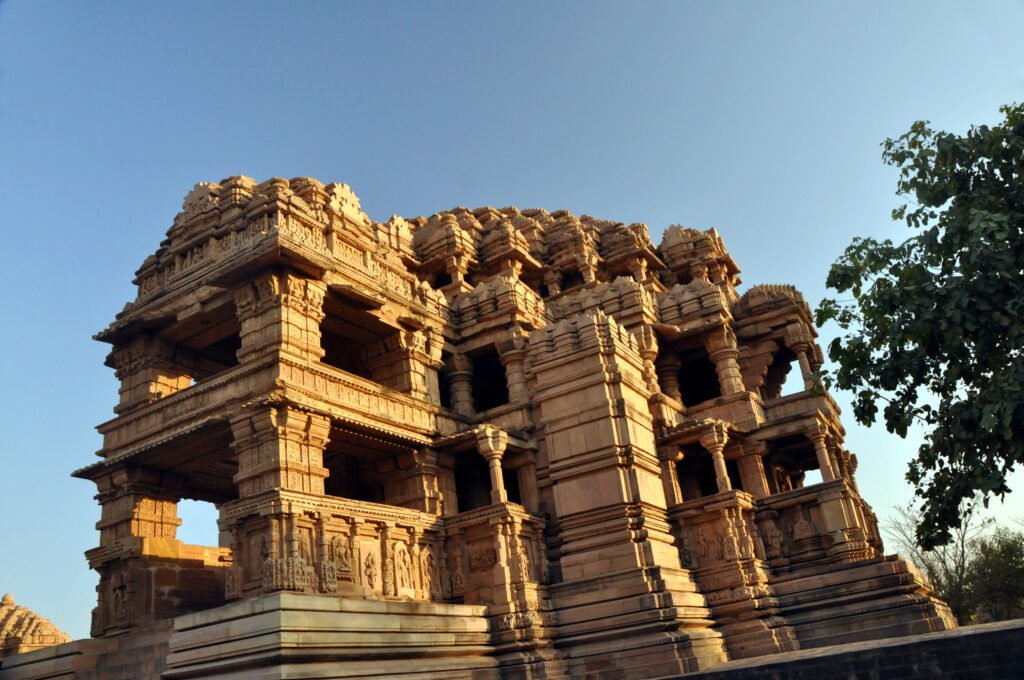
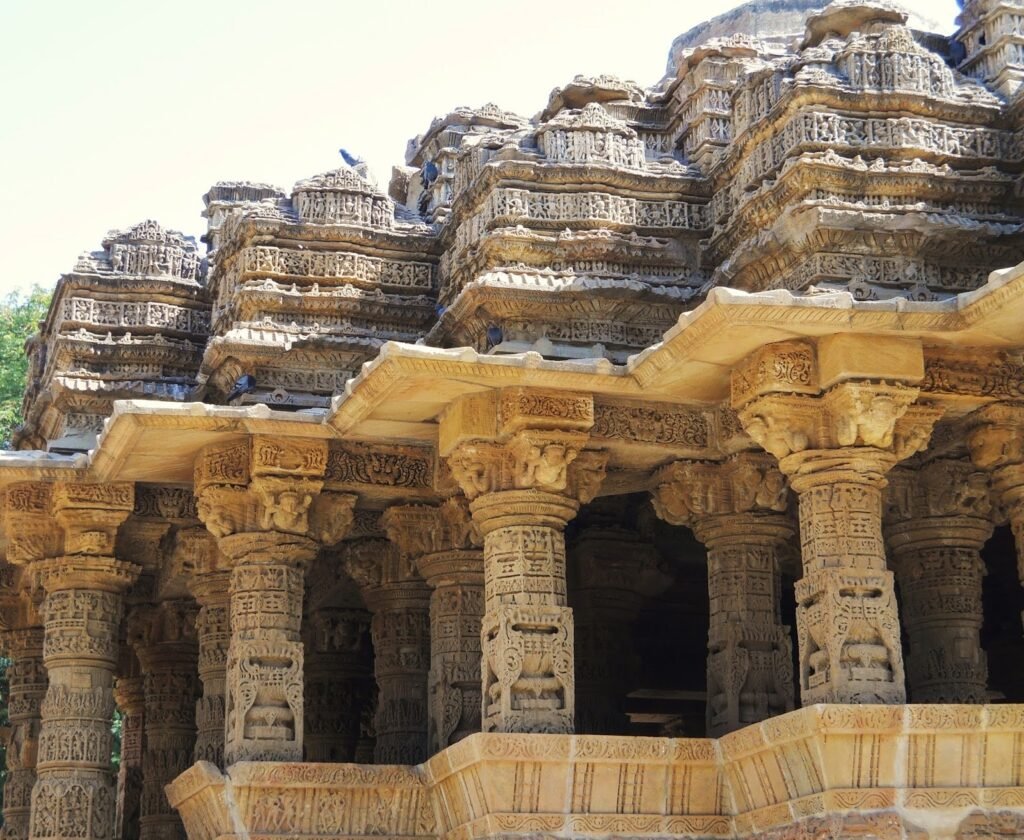
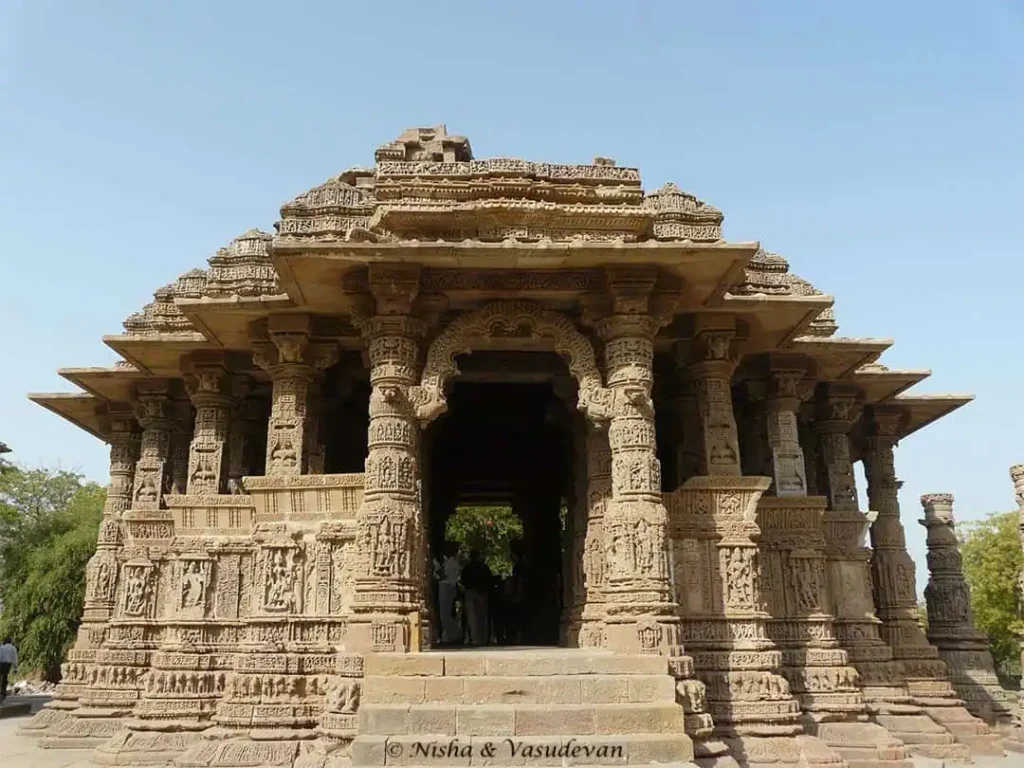
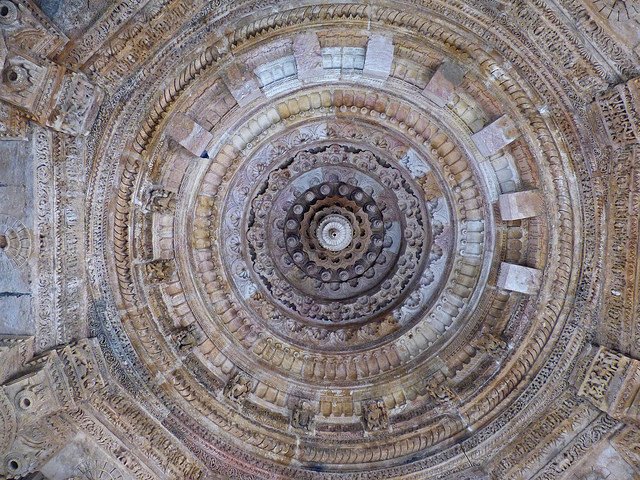
This hall functioned as a space for ritual performances and gatherings. Its pillars contain intricate shrinkara (miniature temple) forms, and its layout symbolizes the solar calendar.
3. Guda Mandapa (Sanctum / Shrine Hall)
The sanctum once housed a 5-foot-tall golden statue of the east-facing Sun God, adorned with gold and diamond jewelry, maintained for nearly 50–60 years before the temple’s destruction.
At the entrance, the Shringar Chauki features carvings of Lord Ganesha and Kubera, the deity of wealth, symbolizing auspicious beginnings and prosperity.
Destruction, Rehabilitation, and Current Condition
The temple had a tough time back in the 12th century. This was when the Khilji forces came and invaded the place. They caused a lot of damage to the temple. The top part of the temple was badly hurt. For a long time, almost 900 years, the inside of the temple was open to the sky. The inner chamber of the temple had no roof to protect it from the elements. The temple and its inner chamber stayed like this for a long time.
The site is now stable and safe because the local government and the Archaeological Survey of India are taking care of it. The temple is:
Ceased to be a functioning site for religious services.
Safeguarded as a National Landmark.
Acknowledged as a UNESCO World Heritage Site.
The Suriya Kundh in Modhera is really something. It is not a reservoir or something that is part of a temple. The Suriya Kundh in Modhera is a stone structure that shows how good India is at science, spirituality and architecture.
The Suriya Kundh in Modhera has a special design that is connected to the universe and it has a great system for water. The Suriya Kundh in Modhera also has sculptures that tell stories and the shapes are very precise. The Suriya Kundh in Modhera shows us what the culture was like. The people who built the Suriya Kundh, in Modhera thought that nature was very important and beautiful but something that could be understood and studied. Even in quietude today, the stones of Modhera still convey messages—about illumination, duration, and a knowledge framework that was well ahead of its time.