

The Tigris and Euphrates shaped the civilizations of Mesopotamia, in modern Iraq and neighboring regions, rather than Egypt directly. Ancient Egyptian civilization developed along the Nile. Nevertheless, the societies that emerged between the Tigris and Euphrates influenced Egypt through trade, artistic exchange, political competition, and eventually conquest. Understanding this relationship requires separating the Nile’s direct environmental importance from Mesopotamia’s more indirect cultural and technological influence.
Map of the Tigris–Euphrates basin. Map by Dr. Blofeld, based on maps-for-free.com; licensed CC BY 3.0. Source: Wikimedia Commons.

1. Two River Systems, Two Paths to Civilization
The Tigris and Euphrates in Mesopotamia
The Tigris and Euphrates carried water and sediment into the plains of Mesopotamia. In the dry south, irrigation made intensive farming possible and helped support cities such as Uruk, Ur, and later Babylon. During the fourth millennium BCE, agricultural surpluses, specialized labor, religious institutions, and administrative systems contributed to the emergence of complex urban societies.
These rivers also presented engineering challenges. Flooding could be destructive, channels could shift, and irrigation canals accumulated sediment. Communities repeatedly repaired embankments, cleared waterways, and negotiated access to water. In some areas, inadequate drainage and evaporation increased soil salinity, damaging agricultural productivity over time. Susan Pollock’s Ancient Mesopotamia: The Eden That Never Was emphasizes that this environment supported civilization through sustained labor and social organization, not effortless natural abundance.
The Nile in Egypt
The Nile’s annual inundation generally followed a more regular seasonal rhythm than flooding in Mesopotamia. It replenished agricultural soils and supplied water to fields along a narrow valley and broad delta. Egyptian farmers used flood basins, embankments, and channels to manage this water, although the scale and organization of these works changed over time. Floods that were too low or too high could still cause serious hardship.
The Nile also connected settlements through river transport. Its navigable corridor helped rulers move grain, officials, soldiers, and building materials. Egypt’s political unification around 3100 BCE cannot be explained by geography alone, but this transportation network helped sustain a territorial kingdom. Mesopotamia, by contrast, long contained competing city-states before larger kingdoms and empires repeatedly united parts of the region.
2. How Mesopotamian Influence Reached Early Egypt
Egypt was not isolated during its formative centuries. In the late fourth millennium BCE, overlapping exchange networks connected Egypt with the Levant and, indirectly, Mesopotamia. Objects, artistic motifs, and administrative practices could travel through intermediaries without requiring direct contact between Egyptian rulers and Mesopotamian cities.
- Cylinder seals: Rolling an engraved cylinder across wet clay produced a repeated design. This technology, especially associated with Mesopotamia, appeared in early Egypt and was adapted for local administrative purposes.
- Artistic imagery: Some late Predynastic Egyptian objects feature intertwined animals, powerful figures controlling animals, and other compositions with Near Eastern parallels.
- Architectural decoration: Recessed mudbrick façades in early Egyptian elite architecture resemble features found in Mesopotamian buildings, although the route and extent of influence remain debated.
These similarities do not mean that Mesopotamians created Egyptian civilization. Egyptian kingship, religious traditions, and monumental architecture developed through local processes. Barry J. Kemp’s Ancient Egypt: Anatomy of a Civilization provides a framework for understanding how Egyptian institutions incorporated outside contacts while retaining distinctive forms. Likewise, contact between the regions does not establish that Egyptian hieroglyphic writing was simply copied from Mesopotamian cuneiform.
3. Architectural Materials and Early Building Techniques
Mudbrick as a Shared Technology
Both regions used sun-dried mudbrick extensively. Builders mixed earth with water and often plant material, shaped bricks in molds, and dried them before construction. Thick brick walls provided structural mass and moderated indoor temperatures. Surfaces required maintenance because exposed earth deteriorated under moisture and weathering. Mudbrick was a practical response to available resources, however, not proof that one civilization borrowed all its building methods from the other.
Southern Mesopotamia had abundant clay but relatively limited local supplies of large building stone and timber. Builders therefore developed sophisticated brick traditions, using buttresses, recessed wall surfaces, and, in certain applications, baked brick and bitumen for greater durability or moisture resistance. Egypt also relied on mudbrick for houses, palaces, enclosure walls, and many early tombs, but its access to limestone, sandstone, and granite encouraged a different monumental tradition.
Recessed Façades and Egyptian Adaptation
Early Egyptian royal and elite architecture used alternating projections and recesses, often described as palace-façade decoration. This treatment created patterned shadows and emphasized the status of the building. Comparable façades existed in Mesopotamia, making architectural exchange plausible. Nevertheless, surviving evidence does not establish a simple sequence in which Egyptian builders copied a single Mesopotamian model.
In Egypt, this architectural language acquired specifically royal and funerary meanings. It appeared in monumental tombs, royal imagery, and later stone representations of earlier building forms. Its importance lies not only in possible foreign inspiration but also in the way Egyptian craftsmen transformed a wall treatment into a lasting expression of kingship.
1846 lithograph of the entrance to Luxor Temple, by David Roberts and Louis Haghe. Public domain; Library of Congress / Wikimedia Commons.

4. Why Egyptian Pyramids Were Not Mesopotamian Ziggurats
Egypt’s Development from Tombs to Stone Complexes
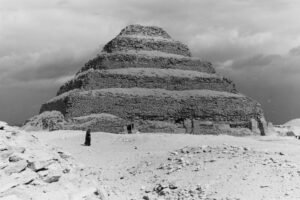
Egyptian pyramid architecture emerged from local funerary traditions, including rectangular mastaba tombs. During the Third Dynasty, in the twenty-seventh century BCE, Djoser’s Step Pyramid complex at Saqqara marked a major expansion of monumental stone construction. Its builders translated forms associated with reeds, timber, and mudbrick into worked limestone, creating an enduring ceremonial landscape for the king.
Under Fourth Dynasty rulers, pyramid construction developed through major experiments, including Sneferu’s Bent and Red Pyramids and the pyramids at Giza. Engineers refined foundations, stone placement, chamber construction, and the distribution of enormous loads. Mark Lehner’s The Complete Pyramids places these monuments within a sequence of Egyptian experimentation rather than treating them as sudden imports from abroad.
Mesopotamia’s Temple Platforms

Mesopotamian ziggurats developed from traditions of elevated temple platforms. The best-known monumental examples, including the ziggurat at Ur, belong to the late third millennium BCE and later. Their primary purpose was religious elevation: they supported sacred buildings above the surrounding settlement. Egyptian pyramids, by contrast, formed the central monuments of royal funerary complexes.
- Function: Ziggurats elevated temples; Egyptian pyramids served royal burial and mortuary worship.
- Materials: Ziggurats commonly combined mudbrick cores with baked-brick facing; major Egyptian pyramids predominantly used stone.
- Engineering: Ziggurats required protection of brick masses from water; pyramids required precise masonry, stable foundations, and carefully designed internal spaces.
- Historical relationship: Their stepped or towering appearances do not demonstrate that Egyptian pyramids derived from Mesopotamian ziggurats.
5. River Transport, Engineering, and State Power
The strongest connection between the two regions is comparative: both show how water management and transportation supported complex states. Mesopotamian canals supplied fields and carried goods, linking agricultural production to urban institutions. In Egypt, the Nile and associated waterways helped deliver food, workers, and heavy materials to royal construction projects.
Egyptian builders transported stone by boat where routes permitted and moved heavy loads overland using sledges and prepared surfaces. Construction required coordinated quarrying, surveying, provisioning, and skilled labor. Ramps were part of Egyptian building practice, although the precise arrangements used at individual pyramids remain debated. Dieter Arnold’s Building in Egypt: Pharaonic Stone Masonry explains the technical sophistication of this stone-building tradition.
Neither civilization’s government should be explained simply as the inevitable result of irrigation. Religious authority, warfare, trade, labor organization, and local political struggles also shaped institutions. The rivers created opportunities and constraints; people developed different political and architectural responses.
6. Later Influence Through Diplomacy and Conquest
By the second millennium BCE, Egypt participated in an international diplomatic system linking major Near Eastern kingdoms. The fourteenth-century BCE Amarna letters include correspondence with Babylonian and Assyrian rulers. Much of this communication used Akkadian written in cuneiform, demonstrating the international prestige of a scribal tradition rooted in Mesopotamia.
In the first millennium BCE, contact became more confrontational. The Assyrian king Esarhaddon captured Memphis in 671 BCE, and forces of Ashurbanipal sacked Thebes in 663 BCE. These campaigns brought a Mesopotamian imperial power directly into Egyptian political affairs. Their consequences included disruption, extraction of wealth, and changing relationships with local rulers, rather than the replacement of Egyptian architecture by Assyrian building traditions.
Assyrian relief from Nimrud showing archers at a besieged city, c. 728 BCE. Photo by ChrisO; public domain, Wikimedia Commons.

Ultimately, the Tigris and Euphrates influenced Egypt by sustaining neighboring civilizations whose goods, imagery, diplomatic practices, and armies entered Egypt’s world. The Nile remained the direct foundation of Egyptian agriculture, transport, and monumental construction. Egyptian civilization evolved through this combination of a distinctive local environment and selective participation in a wider ancient Near Eastern world.